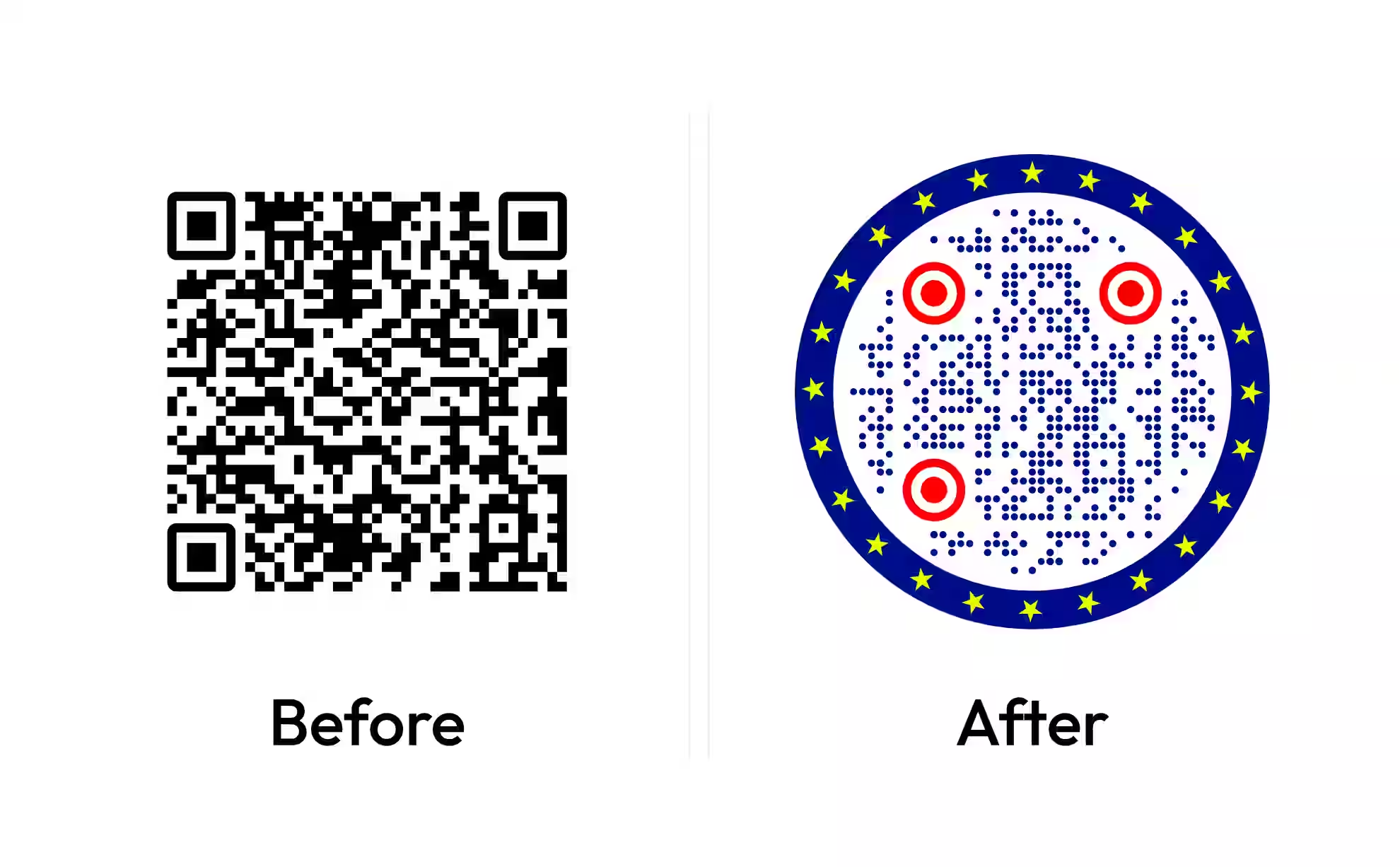
Best Free QR Code Generators in 2026
by KoloQR TeamIndustry
Every generator in this piece is free, and three different things are being offered under that word: a static code with nothing behind it, a dynamic code that routes through somebody's server, and a trial that becomes a subscription. Only the first survives you walking away. These are the free tiers as they stood in August 2026, read off each vendor's own page - free tiers move, so treat this as a snapshot rather than a standing recommendation.
Key Points
- Free means one of three arrangements: a static code you keep, a dynamic code you rent, or a trial that ends. Only a static code has no running cost and no dependency.
- QRCode Monkey exports PNG, SVG, PDF and EPS with no account, and its own FAQ notes that the logo and design settings currently only work for the .png and .svg files - so the vector export can arrive without the logo you added.
- ME-QR's free dynamic codes are real and don't expire, and they display advertising on the way to your page. Its Lite plan, at $7 per month, removes ads from one code in total.
- Bitly's free plan includes 2 QR codes per month, and they redirect through Bitly, so a printed code depends on that account continuing to exist.
- Segno generates codes offline, in Python, with no dependencies and no service involved at all - the only entry here that cannot be discontinued.
Free Means Three Different Things
The word free is doing three unrelated jobs on QR code generator pricing pages, and the difference only becomes visible after something is printed. A free static generator gives you a file and has no further relationship with you. A free dynamic tier gives you a redirect that somebody else operates. A free trial gives you the platform until a quota or a clock runs out.
A static QR code is a code with the destination written directly into the pattern, so nothing sits between the scan and the page it opens. That is why it has no running cost: there is no server to keep alive, no account to keep, and no company that can switch it off. It is also why it cannot be edited after printing - the URL is physically in the squares.
A dynamic QR code is a code that encodes a short link belonging to the provider, which redirects to wherever you currently point it. That indirection is genuinely useful - it is what lets you fix a wrong link after 5,000 flyers are printed, and what makes scan counting possible at all - and it is also the dependency. The printed pattern points at the provider, so the provider is now part of your sign.
| What you're offered | What it costs later | What happens if you walk away |
|---|---|---|
| A free static code | Nothing, because there is no service behind it | The code keeps resolving - the URL is in the pattern |
| A free dynamic code | Ads on the free tier, or a subscription to remove them | The short link stops resolving and the printed code is dead |
| A free trial of a platform | A monthly plan once the quota or the clock runs out | Dynamic codes stop; static files you exported still work |
The practical consequence is that the question is not which generator is best. It is whether this particular code will ever need to change or be counted. If it will not - and most codes on a menu, a business card, a wine label or a museum wall never will - a free static generator finishes the job permanently, and every subscription above it is buying infrastructure the project will not use.
The Free Static Generators: Codes You Keep
Four tools produce static codes for nothing, with no account and no expiry, and they differ mainly in how much design control they hand you. All four are usable commercially, and none of them can tell you how many times a code was scanned.
QRCode Monkey
QRCode Monkey is the long-established default in this category, and it earns it: no signup, PNG, SVG, PDF and EPS export, and detailed control over the body dots and the corner elements. Its own FAQ states that codes "do not expire and will work forever", that there is no scan limit, and that a logo can cover up to about 30% of the code because error correction can recover that much.
The caveat is one that costs people a print run, and it is stated on QRCode Monkey's own page rather than inferred: the logo and design settings currently only work for the .png and .svg files. If your printer asked for EPS or PDF and you sent the vector straight from the download panel, the file can arrive without the logo and styling you spent twenty minutes on. Open the export before it goes anywhere.
goQR.me
goQR.me is the plainest option here and the fastest when the code has no design requirement at all. It generates without an account, exports PNG, GIF and JPEG as well as PDF, SVG and EPS vectors, and states explicitly that the codes may be placed on leaflets, posters, business cards or other products at no cost, including commercial use. It also exposes a documented API, which makes it the easy pick for generating a batch from a script.
There is almost no styling here beyond size and colour - no shaped modules, no frames. For a Wi-Fi code taped inside a cupboard door, that is the correct amount of tool.
Segno
Segno is not a website. It is a QR code generator that runs on your own machine as a Python library or a command-line tool, and it is the only entry on this page that no company can discontinue. Its documentation describes it as a pure Python QR code generator with no dependencies, generating codes according to ISO/IEC 18004:2015(E), including Micro QR codes, and serialising to SVG, PNG, EPS and PDF.
Segno is the right answer to a question the web tools answer badly: generating a thousand codes, or generating codes for data that must not leave your network. It is the wrong answer if you want to see what the code looks like before you commit to it, because there is no preview and no design surface - you write a line, you get a file.
KoloQR
KoloQR, a free QR code generator with circular and custom-shaped QR codes, is the design-led option in this group: it changes the outline of the code itself - circular, rectangular, triangular, hexagonal - rather than only styling the dots inside a square. It exports SVG, PDF and EPS with no account and no watermark, checks contrast before you export, and copies straight into Figma. The source is open, so it can be inspected or self-hosted.
KoloQR is also the newest tool in this group, which is a real argument against it if what you want is a track record - QRCode Monkey has years of production use behind it and KoloQR does not. And it makes static codes only: no dynamic codes, no scan analytics, no dashboard. If you need to count scans, stop reading here and buy a platform, because KoloQR is not that.
The Free Dynamic Codes: Codes You Rent
Two services give away the thing everyone else charges for - a dynamic code, editable after printing - and both are honest about it if you read closely. What they charge instead is worth understanding before a code goes on something expensive.
ME-QR
ME-QR gives away dynamic codes at a scale that is hard to argue with: its pricing page lists 10,000 codes on the free tier, unlimited scans with no expiration, and a year of analytics history. An account is required to change a code's destination, which is reasonable, since the destination now lives in an account rather than in the pattern.
The price is advertising. Free ME-QR codes display ads, and the pricing page makes the cost of removing them unusually legible: the $7 per month Lite plan buys one ad-free QR code in total, and the $20 per month Premium plan makes all codes ad-free. That is a fair trade for an internal code or a personal link. It is a poor trade for a restaurant table, where the customer meets an advertisement between scanning your code and reading your menu - which is the reason this site describes itself as an ad-free ME-QR alternative.
Bitly
Bitly's free plan includes 2 QR codes per month, with unlimited scans and no historical analytics retention. Two is enough to test the product and not enough to run anything, which is the intent - Bitly's free tier is a sample of a link management platform, not a QR generator.
The Bitly codes are redirect-based, so the printed pattern points at Bitly and Bitly points at you. That works well until an account lapses, a plan changes, or a link is archived, at which point the artifact in the world stops matching the artifact in the dashboard. For a two-week campaign that is a non-issue. For a plaque, it is the whole issue.
Where the Free Tier Is the Trial
A larger group of tools - QR Tiger, QRFY, Scanova, Uniqode, QRCodeChimp, Flowcode, qr.io, QRStuff - appear in every "free QR code generator" list and belong in a different category. These are subscription QR management platforms. Their free tiers exist to demonstrate dynamic codes, analytics, bulk generation and team features, and what varies between them is which parts stop when you stop paying.
The mechanism is the same everywhere and worth stating plainly: a dynamic code routes through a short link that the plan keeps alive, so it stops resolving when the subscription or trial ends. Anything you exported as a static file keeps working, because a static file has no plan attached. This is not a criticism of these platforms - if a code has to be re-pointed after printing or its scans counted, a subscription is the correct purchase and no free static tool substitutes for it.
Because the specifics differ per vendor and change often, the per-tool detail lives on the comparison pages rather than here: QR Tiger, QRFY, Scanova, Uniqode, QRCodeChimp, Flowcode, qr.io and QRStuff. Seven of them are also set against each other, rather than against KoloQR, in Flowcode alternatives. Whether QRFY's free tier is enough on its own is the question Is QRFY free? answers.
One check applies to all of them before you commit a design: export the file you intend to print, on the free tier, and look at it. A watermark, a resolution cap or a missing vector format is easier to discover now than after the code is approved.
How to Choose, in One Question
Ask whether the destination will ever have to change after the code is printed. That single question sorts every tool on this page, and it sorts them better than any feature table, because it is the only difference that cannot be worked around later.
- The link will never change. Use a free static generator and stop paying attention to this category. Menus, Wi-Fi codes, business cards, product labels, gravestones and museum captions are all in this group.
- The link might change, and the print run is small. Still use a static code, and reprint. Reprinting fifty table tents costs less than five years of a subscription bought to avoid it.
- The link will change, or the scans must be counted. Buy a dynamic platform, and treat the subscription as part of the campaign budget rather than an accident.
- You need a thousand codes, or the data cannot leave the building. Use Segno and generate them offline.
- The code has to look like it belongs to the brand. Compare on design range and vector export rather than on price, since the static tools all cost the same amount: nothing.
The one thing worth spending on, if you spend anything, is not the generator. It is testing: scan the final exported file with two different phones before it is printed, at the size it will actually appear. That catches more failures than any feature on any pricing page.
What None of the Free Tools Do
No free static generator can tell you how many people scanned a code, and none can change where a printed code points. Those two capabilities are the entire product being sold by the platforms in the section above, and they are genuinely worth money to the people who need them. A free static tool is not a cheaper version of a QR platform - it is a different object, and the honest comparison says so.
The failure that free generators do not cause, and that gets blamed on them, is a code that will not scan. A code fails because it is too small, because the contrast is too low, because the quiet zone is crowded, or because a logo covered more of the pattern than the error correction level could recover. Those are decisions made in whichever tool you chose, and they are fixable in the generator before the file leaves your screen - which is the only part of this entire comparison that affects whether the thing works.
Make Your QR Code
Free, with no account and no watermark. Choose a shape, add a logo, check the contrast, and export SVG, PDF, EPS or PNG - a static code with no subscription behind it.
Generate QR CodeQuestions? Answered
There isn't one answer, because the tools split by job rather than by quality. For a styled code with a track record, QRCode Monkey. For a plain code in ten seconds or via an API, goQR.me. For a thousand codes offline, Segno. For a code whose shape has to match a brand, KoloQR. For editing a link after printing, none of them - that needs a paid dynamic platform.
A free static code never expires, because the destination is encoded in the pattern and no service sits behind it. A free dynamic code can stop working at any time, since it redirects through the provider's short link and that link depends on the account and plan staying active. If permanence matters, the question to ask a generator is not whether it is free but whether the code is static.
Some generators apply design settings to only some export formats. QRCode Monkey states in its own FAQ that the logo and design settings currently work only for .png and .svg files, so a PDF or EPS downloaded from the same panel can arrive as a plain black-and-white code. Always open the exported file before sending it to a printer, whichever tool produced it.
Because the code is dynamic and the free tier is funded by advertising. ME-QR, for example, shows ads on free codes and sells ad-free codes from $7 per month. The ad appears between the scan and your page, which is invisible to you when testing your own link and very visible to a customer. A static code cannot do this, since there is no redirect to insert anything into.
Yes, with the mainstream free static generators. QRCode Monkey states that codes created with it are free and can be used for whatever you want, and goQR.me states that its codes may be used on leaflets, posters, business cards and other products including commercial use, at no cost. The QR format itself is an open standard, ISO/IEC 18004, with no licence or per-code fee.
Only by accepting a dependency. ME-QR's free tier includes a year of analytics history on ad-supported dynamic codes, and Bitly's free plan gives 2 QR codes a month with unlimited scans but no historical data. Both count scans because both own the redirect. If you want the numbers without renting a redirect, the alternative is pointing a static code at a URL you already measure - a landing page with its own analytics and a campaign parameter.
Yes, whenever the code has to change or be measured after printing. That is a real capability no static tool provides, and platforms such as Uniqode, QR Tiger and Scanova sell it along with bulk generation, team access and compliance certifications. The mistake is buying it for a code that will point at the same URL for its whole life, which describes most printed codes.
Keep Exploring
Pages that pick up where this one leaves off - the same setting, the same kind of code, or the next thing worth deciding.
Seven Flowcode Alternatives and What Each Replaces
Flowcode's free plan stops at 2 codes and 500 scans, and the first paid step is $25 a month - here is what seven alternatives cost, and why none of them can rescue a code that is already printed.
How to Create a QR Code in Canva and Export It So It Still Scans
The six steps to make a QR code inside a Canva design, the export setting that decides whether it prints sharp, and how to bring in a circular or vector code when Canva's square one is not enough.
Do QR Codes Expire? The Pattern Never Does
The pattern never expires, and four things behind it do. Which one failed, how to tell them apart, and which of them you can fix without reprinting.
Static or Dynamic? Decide It Before Anything Is Printed
The difference is where the destination lives, and price, analytics and every failure mode follow from it. Four questions that settle which one to print.
QRCode Monkey Is Genuinely Free, and Its PDF Is Not Vector
QRCode Monkey's free tier is real, and two things in it are not what they look like - the upsell inside the editor, and a PDF export that turns out to be a picture of a QR code rather than a vector one.
A Round QR Code Is a Square QR Code in a Costume
Shaped codes scan, because the shape never touches the data. What a shape actually costs is width: a triangular code needs a base about 2.6 times the width of the matrix inside it.
Why KoloQR?
- Create QR codes for websites, menus, Wi-Fi, PDFs, and business cards
- Customize colors, logos, and unique shapes
- Download high-quality PNG and SVG files
- Built for both print and digital