How Do You Put a QR Code on Product Packaging?
A QR code on packaging turns the few square centimetres you can spare into everything that never fit on the pack: ingredients, instructions, disposal, a reorder link. Make one below, then read on for the size it has to be printed at, the finishes that stop it scanning, and what to check before a print run you cannot recall.
Opens in Google Maps. Coordinates work too - "37.4224, -122.0841".
The code opens your business's "Write a review" form. Paste the Place ID, or a Google Maps link that carries one.
A UPI link carries no checksum, so a mistyped ID produces a code that scans perfectly and pays somebody else. Paste the ID from your payment app rather than typing it, and send yourself one rupee before printing.
Paste it exactly as copied. KoloQR does not assemble the payload - it encodes the one your bank issued, and checks it before you print it.
SVG, PNG, JPG • Max 2 MB
First month free
then $9/month
Dynamic QR Codes Are Coming
Change your link anytime, even after printing. See who scans, when and where.
- Edit without reprinting
- Scan analytics
- Bulk & custom domains
You're on the List
We'll email you once, when dynamic codes with scan analytics launch.
What Size Should a QR Code on Packaging Be?
Print it at 2 x 2 cm or larger. The working rule is ten to one: a QR code needs about 1 cm of width for every 10 cm of scanning distance, so a pack picked up and held at 30 cm wants roughly 3 cm, and a code meant to be read from the shelf at 60 cm wants about 6 cm.
- Module Size - the module is the smallest square in the pattern. Keep it at 0.5 mm or larger at final printed size; below that, ink spread on absorbent board starts closing the gaps between modules and the camera stops resolving them.
- Quiet Zone - the quiet zone is the empty margin around a QR code that lets a scanner find where the symbol begins. The standard asks for four modules on every side: on a 2 cm code with 25 modules across, that is about 3 mm of blank pack with nothing crossing it.
- Error Correction - error correction is the redundancy that keeps a code readable when part of it is damaged. Level M recovers roughly 15% and is the sensible default; level Q (about 25%) is worth the extra density on a pouch that creases or a label that scuffs.
- The Panel, Not the Layout - measure the flat area you actually have once the die-line, the seal and the folds are drawn. A code that fits the layout but lands across a crease is a code nobody in a shop can scan.
None of this replaces a printed proof. Ink spread, board colour and varnish all change the finished contrast, so the only size that counts is the one that scans on the real substrate with an ordinary phone - the minimum size for print guide covers how that number is arrived at.
Generate QR CodeWhat to Link a Packaging QR Code To
The pack has run out of room; the page behind the code has not. These are the destinations that repay the space a code takes on a carton, pouch or label.
Ingredients and Allergens
Full ingredient lists, allergen warnings and nutrition tables, in every language you sell in, without a fold-out label. EU wine labelling rules that took effect in December 2023 can be met this way: the ingredient list and nutrition declaration sit on an e-label reached by a QR code on the bottle.
How to Use It
Assembly, dosage, first wash, running-in - the instructions that get thrown out with the box. A ninety-second video answers what a folded leaflet in six languages never does, and it can be corrected long after the packaging is printed.
Recycling and Disposal
Which part of the pack goes in which bin, under the scheme that applies where the buyer actually lives. Collection rules differ by country and often by city, and a web page can be regional in a way a printed symbol cannot.
Reorder in One Scan
A link straight to the product page for the consumable that has just run out. The empty pack is in the customer's hand at the exact moment the decision gets made, which is the one advantage packaging has over every other channel you own.
Proof of Authenticity
A different code on every unit, printed as variable data, so a scan can report whether that code has been seen before. Worth it in categories with a counterfeiting problem - and it needs variable-data printing and a service behind it, not a single static code repeated across the run.
Registration and Recalls
Warranty registration, batch lookup, or a safety notice published after the product shipped. The scan reaches an owner you would otherwise have no way to contact once the pack has left the shop.
How to Make a QR Code for Product Packaging
Five steps from an empty panel to a file your printer can place in the artwork. The whole of it takes a few minutes, and only the last step is hard to undo.
Generate QR Code- 1
Decide What the Scan Opens
Pick one destination and write it down before you design anything. A code that leads to a homepage is scanned once and never again; a code that leads to the allergen table for the product in the buyer's hand is one they show to someone else.
- 2
Point It at a URL You Control
Encode a link on your own domain, such as example.com/p/oat-drink-1l. A static code cannot be edited after printing, but a redirect on your own domain can, so the destination stays changeable for as long as the pack is in circulation.
- 3
Build It at Print Quality
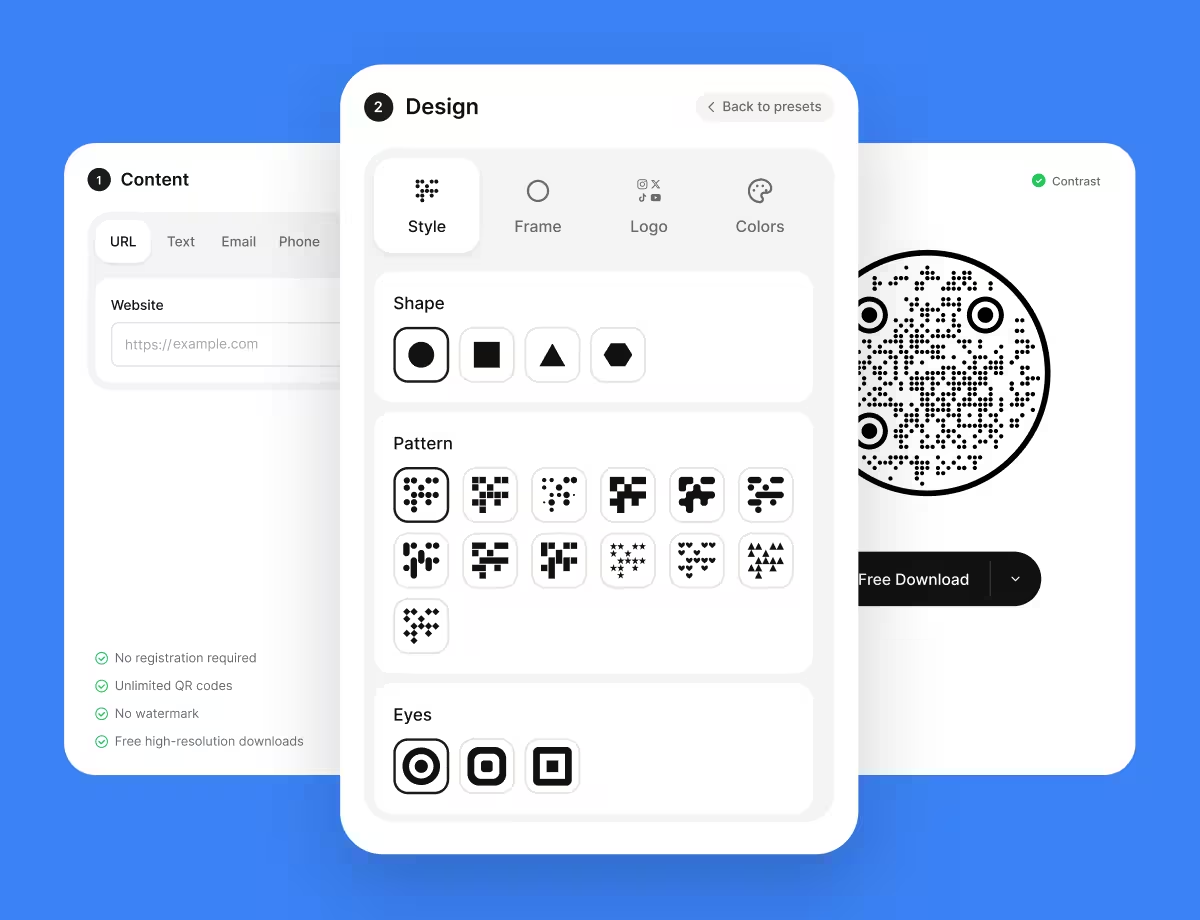
Open the KoloQR generator, choose the URL type, paste the link, then set the shape, colours and logo to match the pack. Export SVG, PDF or EPS - a vector file places at any size in the artwork without the modules softening.
- 4
Fit It to the Panel
Place the code on flat board, away from folds, seals and the retail barcode, with four modules of quiet zone clear on every side. Add four or five words of instruction beside it - 'Scan for ingredients' - so the scan has a stated reason.
- 5
Test the Printed Proof, Not the Screen
Scan the actual proof, on the actual substrate, with an ordinary phone, in shop lighting rather than at your desk. Test it again after varnish or lamination: that is the step that most often turns a working code into a dead one.
Printing a QR Code on Packaging
Packaging is where most QR codes fail, and it is almost always the finish rather than the code. Foil, gloss varnish and metallised board reflect the phone's own light straight back into the lens, so a pattern that scans perfectly on plain paper reads as a bright blank on the shelf.
- Vector, Not Pixels - place an SVG, PDF or EPS in the artwork. A PNG dropped into a layout and then scaled up is the usual cause of soft, thickened modules coming off press - see SVG vs PNG for what each format does at size.
- One Flat Colour - print the dark modules as a single solid ink or a spot colour. A code built out of four-colour halftone loses its edges to registration drift, and a half-millimetre module cannot afford any of it.
- Matte Beats Gloss - a matte varnish or laminate scatters light; a gloss one mirrors it. Where the pack has to be glossy, ask for a matte spot varnish over the code panel alone.
- Not on the Curve, Not on the Seal - keep the symbol on the flattest panel available. On a bottle or a can, a code wrapping much more than a third of the visible face distorts enough for a phone to give up on it.
One more thing to leave alone: the retail barcode. A marketing QR code is not a replacement for the EAN or UPC at the till, and each needs its own quiet zone. GS1's Sunrise 2027 programme is working towards checkouts that can read 2D codes carrying a GTIN, but until a retailer's scanners actually do, the linear barcode stays exactly where it is. What the QR code beside it opens is up to you, such as an Amazon QR code for a product listing.
Generate QR CodeBefore You Send Packaging to Print
A run of fifty thousand cartons is the least forgiving place a QR code can fail. These are the checks worth doing while the file is still changeable.
Scan the Proof, Not the PDF
A screen is backlit, flat and unvarnished; a pack is none of the three. Scan the printed proof with two phones, one iPhone and one Android, before the file goes to plate.
Keep the Quiet Zone Empty
Four modules of blank space on every side, with no ingredient text, no rule, no fold and no die-line crossing it. This is the most common reason a well-made code stops scanning on a busy pack.
Keep the Dark Modules Dark
A dark pattern on a light background, with a real difference between the two rather than two mid-tones. Inverted codes - light modules on a dark pack - are read by many phones and not by all, which is a coin flip to avoid on a print run.
Say What the Scan Does
Four or five words beside the code: 'Scan for ingredients', 'Scan to recycle'. A code with no promise next to it is scanned by almost nobody, and the words cost less pack space than the code does.
Own the Destination
Encode a URL on your own domain rather than a third-party short link that stops working when a subscription lapses. The pack outlives the campaign, and a dead link on a shelf cannot be recalled.
Keep the Landing Page Light
The scan happens in a shop, on mobile data, often on one bar of signal. A page that needs three seconds and several megabytes to show an allergen table has already lost the reader standing in the aisle.
Questions? Answered
At least 2 x 2 cm, and larger when the pack is read from further away. The working rule is 1 cm of code width for every 10 cm of scanning distance, so a box held at 30 cm wants about 3 cm. Below 2 cm, ink spread and shop lighting start costing you scans - the print size calculator works it out from your own distance.
Often not. A metallised or high-gloss surface reflects the phone's own light back into the camera, and the code reads as a bright blank. The usual fixes are a matte spot varnish over the code panel, or printing the code inside a matte white window on the foil. Test the varnished proof, never the flat artwork.
Not the code itself - a static QR code carries the link inside the pattern. Encode a URL on your own domain and change the redirect behind it whenever you need to. That gives you one permanent code on the pack with an editable destination, and no subscription that can switch it off. See URL QR codes for how the payload works. That matters most for seasonal inserts: a Black Friday parcel insert is often opened after the sale has ended.
No. The retail barcode is what the till scans, and it stays. A QR code sits beside it for the shopper, with its own quiet zone. GS1's Sunrise 2027 programme aims to have point-of-sale scanners read 2D codes carrying a GTIN, but until a given retailer's checkout does, removing the linear barcode makes the product unsellable.
A vector file - SVG, PDF or EPS - so the code stays crisp at whatever size the layout needs and the modules keep hard edges on press. PNG is a raster image: fine for a mockup, wrong for production artwork. KoloQR exports SVG, PDF, EPS and PNG, so you can send the first three and keep the last for the presentation.
Yes, within limits. Error correction rebuilds the covered part, so a logo of roughly a tenth of the symbol's area at level Q is safe. Resist enlarging it until it only just scans on your desk: a shelf has less light and a shopper has less patience than you do, and both are what the margin is for.
Three usual causes: shop lighting is dimmer and more directional than office light; the varnish went on after you tested; and the printed code is smaller than the one you scanned on screen. Retest on the varnished proof, at final printed size, in the worst lighting you can find.
For most packs, yes. A static code never expires, needs no account, and depends on no one's servers staying up. You need more only for per-scan analytics or a unique code on every unit, which means variable-data printing and a service to check them against. Everything else is a redirect you already control.
Keep Exploring
Pages that pick up where this one leaves off - the same setting, the same kind of code, or the next thing worth deciding.
Beauty Salons
Rebooking at the chair, per-service aftercare and a portfolio per stylist, with codes that survive acetone, colour and hairspray.
Marketing Agencies
Produce campaign codes for client print runs: sized per placement, exported as vector, and pointed at a redirect the client keeps.
Amazon QR Code
Take a scan straight to a product page, a storefront, or a wish list.
Shopify QR Code
Open a product, a collection, or a pre-filled basket in a single scan.
Stickers & Labels
Die-cut stickers, jar labels and thermal roll stock - the sizes that work, and why clear labels and gloss laminate break scans.
Business Cards
85 x 55 mm leaves room for one code and nothing else - where it goes, how small it can get, and which finishes kill it.
Why KoloQR?
- Create QR codes for websites, menus, Wi-Fi, PDFs, and business cards
- Customize colors, logos, and unique shapes
- Download high-quality PNG and SVG files
- Built for both print and digital