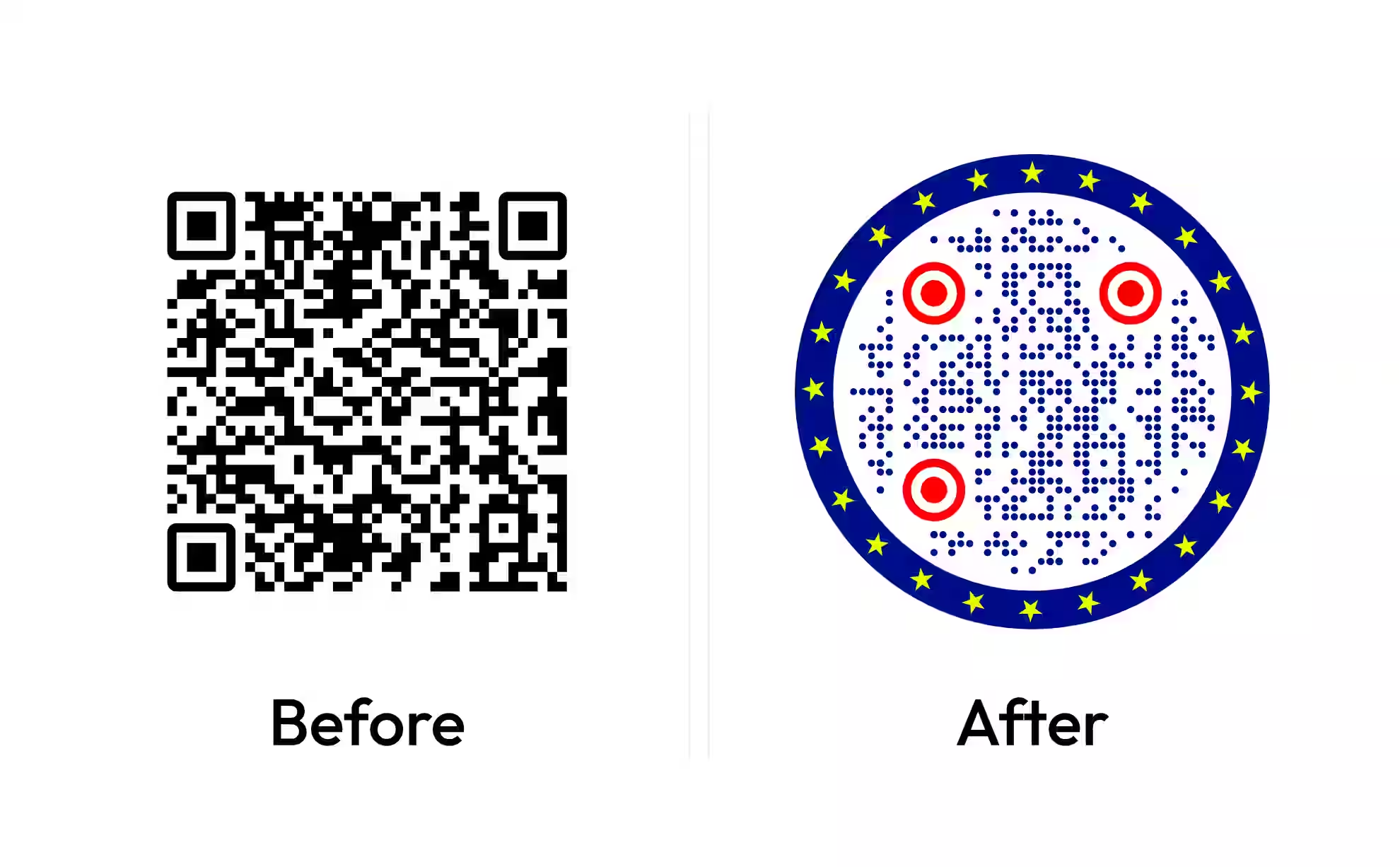
How Do You Put a QR Code on a Poster?
A poster is read from across a room and scanned from an arm's length away, and those two distances want different things. Make the code below, then read on for the size it needs, the height it should hang at, and why the glass in front of it matters as much as the print behind it.
Opens in Google Maps. Coordinates work too - "37.4224, -122.0841".
The code opens your business's "Write a review" form. Paste the Place ID, or a Google Maps link that carries one.
A UPI link carries no checksum, so a mistyped ID produces a code that scans perfectly and pays somebody else. Paste the ID from your payment app rather than typing it, and send yourself one rupee before printing.
Paste it exactly as copied. KoloQR does not assemble the payload - it encodes the one your bank issued, and checks it before you print it.
SVG, PNG, JPG • Max 2 MB
First month free
then $9/month
Dynamic QR Codes Are Coming
Change your link anytime, even after printing. See who scans, when and where.
- Edit without reprinting
- Scan analytics
- Bulk & custom domains
You're on the List
We'll email you once, when dynamic codes with scan analytics launch.
What Size Should a QR Code Be on a Poster?
Size it for the closest a person can get, not for how far away the poster is readable. The ten-to-one rule is about 1 cm of code width for every 10 cm of scanning distance: 10 cm of code for a metre, 20 cm for two metres, 30 cm for three. Below 5 cm, a poster code is decoration.
- The Formats, in Millimetres - A3 is 297 x 420 mm, A2 is 420 x 594 mm, A1 is 594 x 841 mm, A0 is 841 x 1189 mm. A 10 cm code is a quarter of the short side of an A3 and a twelfth of an A0, which is why the same design rarely scales between them.
- Measure the Approach, Not the Wall - if a barrier, a counter or a road keeps people two metres back, that is the scanning distance. A poster behind a shop window is scanned from the pavement, however close the wall is on the inside.
- Hanging Height - put the code between 1.2 and 1.6 metres from the floor. Above 1.8 m people cannot hold a phone steady on it, and below a metre they have to crouch in public.
- Quiet Zone at Scale - four modules on every side still applies. On a 20 cm code that is roughly 3 cm of blank poster, which at that size looks like a design mistake and is not one.
Posters in transit spaces are the exception worth planning for. Someone on a platform has thirty seconds and cannot approach the wall, so the code needs to work from where they are standing - which usually means a much larger code and a much shorter URL than the design wants. The minimum size for print guide has the arithmetic.
Generate QR CodeWhat to Link a Poster QR Code To
A poster gets a glance and a decision. These six destinations are the ones worth the scan that follows, each of them something a wall cannot hold.
Tickets and Registration
The event the poster is advertising, one tap from booking. This is the highest-converting poster code there is, because the reader has already decided and only needs somewhere to do it.
The Full Programme
Times, rooms, line-ups and changes. A poster fixes a schedule at the moment it was printed; a linked page keeps it true when a slot moves.
A Map or Directions
A wayfinding poster that opens navigation to the door, the entrance or the room. In a hospital, a campus or a festival site this is the scan people actually want.
A Trailer or Sample
Thirty seconds of the film, the band or the class. A poster can show one frame; the scan hands over the rest, at the moment interest is highest.
A Feedback or Report Form
Common on public-service and workplace posters: report a fault, leave a comment, raise a concern. The code removes the step where someone has to remember a URL until they are somewhere private.
A Donation Page
For campaign and charity posters, a scan that opens a payment page with the amount already suggested. It converts the moment of sympathy rather than hoping it survives the walk home.
How to Make a QR Code for a Poster
Five steps, starting from a measurement rather than from a design. On a poster the size is the decision that everything else follows.
Generate QR Code- 1
Measure the Closest Approach
Stand where a reader would stand and measure back to the wall. Multiply that distance by 0.1 - two metres becomes 20 cm - and that is the code width the poster needs.
- 2
Shorten the URL
A short link encodes into fewer, larger modules at the same printed size, which is worth more on a poster than on anything else. Use a short path on your own domain rather than a long tracked address.
- 3
Build the Code in Vector
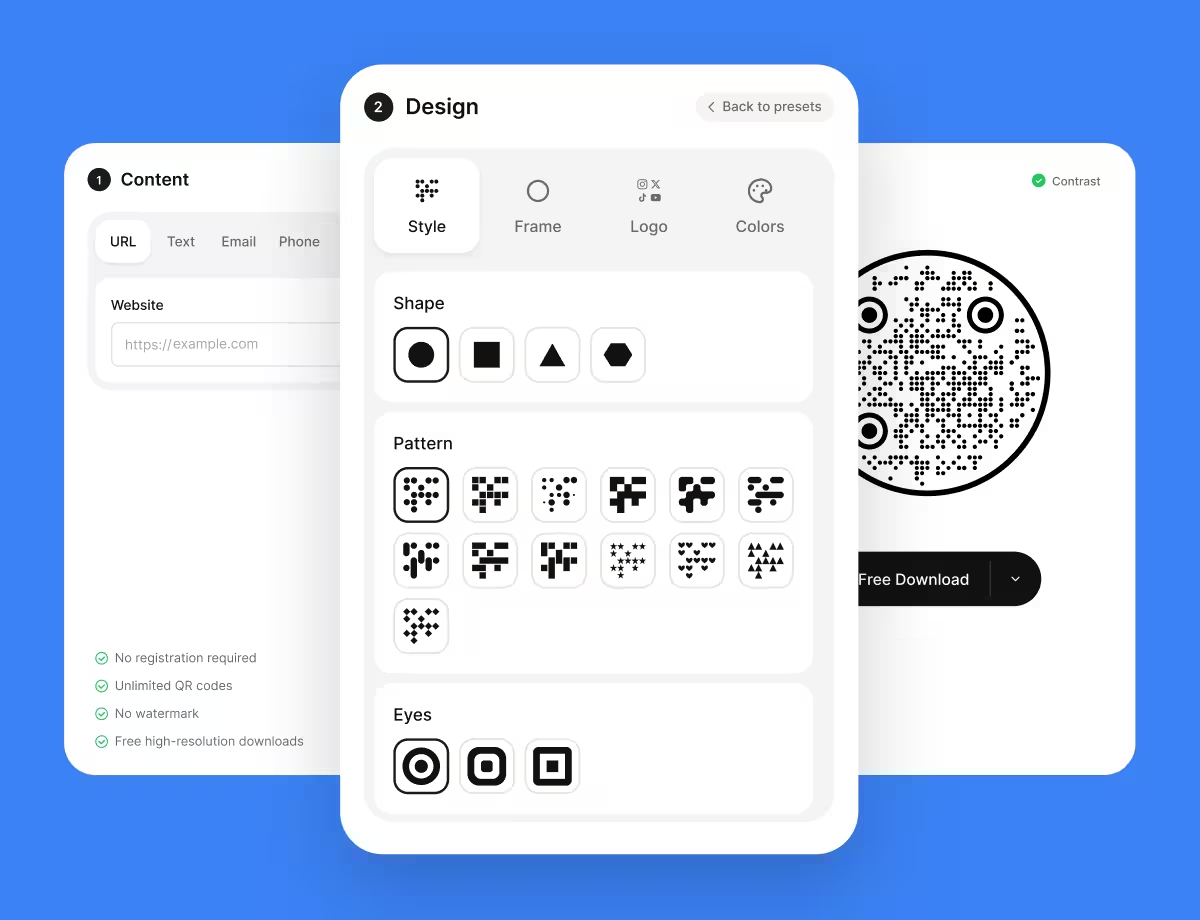
Open the generator above, paste the link, style it to match the poster, then export SVG, PDF or EPS. Large format is where a raster file's softness becomes obvious, and vector removes the question entirely.
- 4
Place It Low and Label It
Bottom third of the poster, between 1.2 and 1.6 m from the floor once hung, with a line of text saying what the scan opens. Keep the quiet zone clear of the border and of any other element.
- 5
Proof It at Full Size
Print the poster, hang it where it will live, and scan it from where people will stand - in that light, through that glass. A test on a desk proof at A4 tells you nothing about an A1 on a wall.
Glass, Gloss and Light on a Poster Code
Most poster codes that fail are the right size and are behind the wrong surface. A glossy laminate, a frame's glass or a shop window each mirror the phone's own light and the venue's overhead lighting back into the lens, which is why a code that scanned in the studio reads as a bright blank in the corridor.
- Matte Lamination - ask for matte on any poster that will live under spotlights. Gloss looks richer on the desk and reflects a light fitting straight into the camera on the wall; matte vs gloss printing has the comparison.
- Non-Reflective Glass, or None - a framed poster behind ordinary glass reflects the room. Anti-glare glass helps; an unframed poster or a snap frame with a matte anti-reflective panel helps more.
- Large Format Prints Coarse - wide-format printers work at 100-150 dpi at final size, which is fine for a code with modules measured in millimetres. Supply vector artwork so the modules stay square rather than resampled.
- Watch the Backlit Case - a lightbox poster is lit from behind, which washes out the difference between dark and light modules. Increase the contrast and the size, and test in the actual case before printing the run.
Posters outlive their campaigns, especially in venues where nobody is paid to take them down. Point the code at a redirect on your own domain so the destination can be moved when the event has passed, rather than leaving a wall full of codes that lead to a 404.
Generate QR CodeBefore the Poster Goes Up
A poster is printed once and hung for months, usually somewhere nobody responsible ever walks past. These are the checks worth making first.
Size From the Barrier, Not the Wall
Counters, rails, roads and desks decide how close a phone can get. Measure to the obstacle rather than to the poster, and size the code from that number.
Hang It Between 1.2 and 1.6 Metres
That band is where a standing adult can hold a phone steady without stretching or crouching. A poster hung at eye level puts its bottom-third code exactly there.
Say What the Scan Does
'Scan for tickets', 'Scan for the timetable'. A code on a poster competes with everything else on the wall, and a promise is what wins the second of attention.
Print the URL as Text
A short readable address under the code serves the reader across the road, the one with a flat battery, and anyone whose camera will not focus in low light.
Test It Through the Glass
Scan the finished poster in its frame, in the venue's own lighting, from the standing position. Glass and spotlights are the two variables no desk test reproduces.
Plan the Afterlife of the Link
Posters stay up long after an event, in venues where nobody is paid to take them down. Redirect the URL to the next thing rather than letting it die.
Questions? Answered
About 1 cm of code width for every 10 cm of scanning distance: 10 cm at one metre, 20 cm at two, 30 cm at three. Size it for the closest someone can physically stand, not for how far away the poster can be read. On A3 that usually means 5-10 cm; on A1, 15-20 cm.
Between 1.2 and 1.6 metres from the floor. Higher than 1.8 m and a standing adult cannot hold a phone steady against it; lower than a metre and they have to crouch in a public corridor. Putting the code in the bottom third of an eye-level poster lands it in that band.
Usually yes, but reflections are the problem rather than the glass. A framed poster under spotlights mirrors the light fitting back into the camera. Anti-glare glass, matte lamination, or angling the frame away from the light source all fix it - and the only real test is scanning it in place.
Only if it is enormous. Ten metres of distance needs roughly a metre of code by the ten-to-one rule, which is most of a large format poster. For anything read at street width, print a short URL in large type as well - people can read and type an address they cannot scan.
Vector - SVG, PDF or EPS. Wide-format printers work at 100-150 dpi at final size, and a raster code enlarged to 20 cm arrives with soft, uneven module edges. A vector file redraws at any size, which is exactly what a poster asks for. Check the finished proof with the QR code validator.
Three usual causes: it is too small for the distance people can actually stand at, the laminate or glass is reflecting the venue's lighting, or the poster is hung too high to hold a phone against. Rescan it in place from a standing position rather than on the studio proof.
Rarely. Two codes on a wall is two decisions for someone walking past, and neither gets made. Use one code for the primary action - tickets, registration, the programme - and let the page behind it carry every other route.
Yes. A static code never expires and needs no subscription keeping it alive, which matters on something hung for a season and forgotten. Point it at a redirect on your own domain and you can move the destination after the event without touching the printed poster - the same habit that keeps a flyer useful months later. For a time-limited promotion such as a Black Friday sale, encode a short URL on your own domain so the poster can point somewhere current once the sale ends.
Keep Exploring
Pages that pick up where this one leaves off - the same setting, the same kind of code, or the next thing worth deciding.
Event QR Codes
One scan connects guests to tickets, schedules, directions and RSVPs - on invites, posters and signage.
Nonprofits
Donation codes for appeal letters, collection tins, event banners and charity shop windows, with sizes in cm and the trust rules that keep them safe.
URL QR Code
Send anyone straight to a web page, landing page, or link with a single scan.
Google Forms QR Code
Open a survey, sign-up sheet, or feedback form straight from a printed page.
Flyers
A5, A6 and DL leaflets - what size the code needs, which corner it belongs in, and how to tell which batch produced the scans.
Invitations
Weddings, parties and formal invitations - where the code belongs, how small it can go, and which finishes and overlays block it.
Why KoloQR?
- Create QR codes for websites, menus, Wi-Fi, PDFs, and business cards
- Customize colors, logos, and unique shapes
- Download high-quality PNG and SVG files
- Built for both print and digital