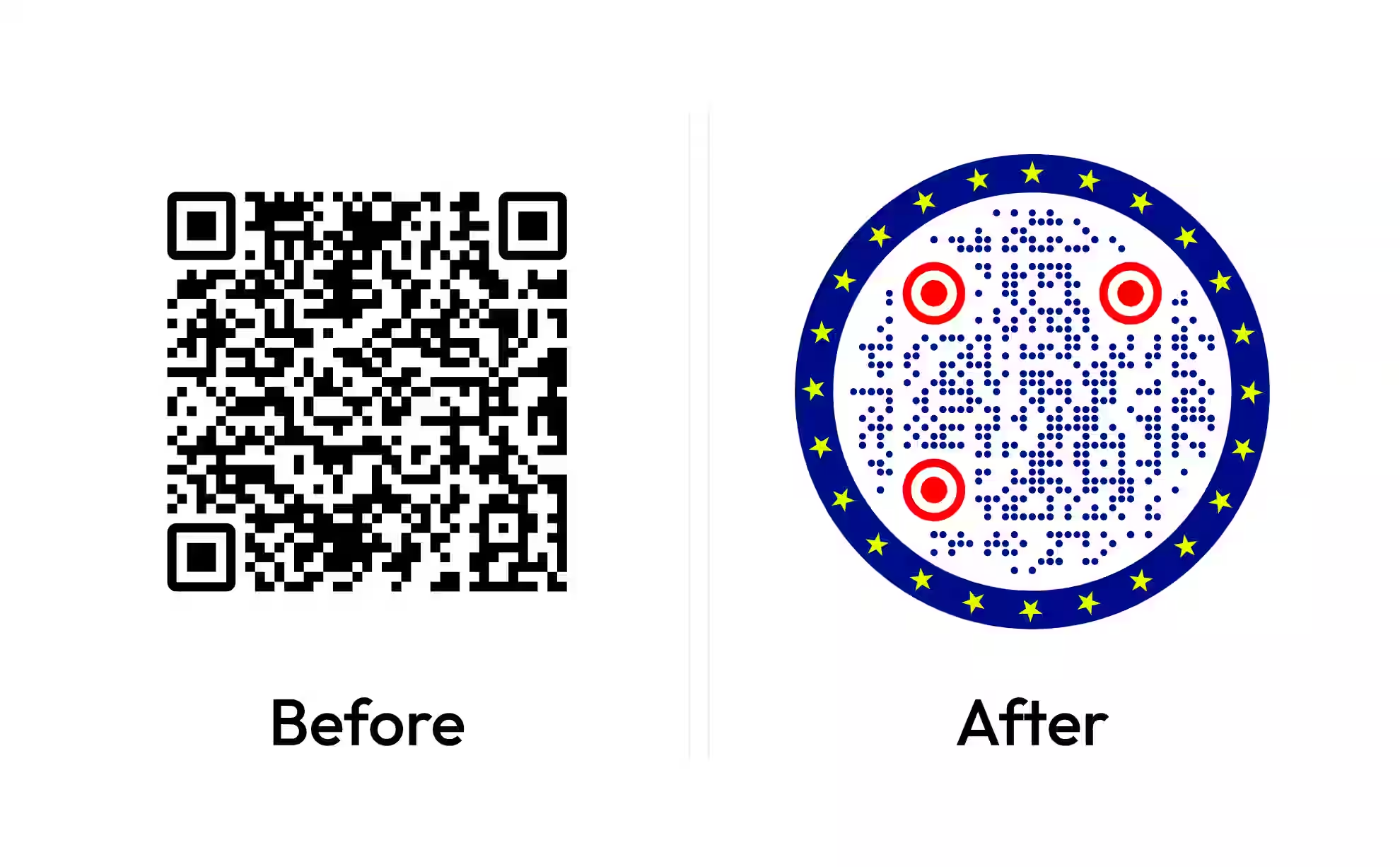
QR Code Tools That Each Answer One Question
Five small tools for the decisions a QR code actually needs: how wide to print it, how many pixels to export, whether the colours scan, what a code says, and whether the file will survive being printed. Every one of them runs in your browser, and none of them asks for a signup.
Pick the Tool for the Question
The first three answer from numbers you already have. The last two answer from a file - drop a code in and it is read and measured on your device.
QR Code Print Size Calculator
Turn a scanning distance, a payload and a material into a minimum width in millimetres, with the module size and quiet zone behind it.
QR Code DPI Calculator
Convert a printed size to a pixel count at any resolution and back, and check what a file actually delivers at the size it is placed.
QR Code Contrast Checker
Judge a colour pair the way a scanner does: the contrast ratio, the luminance difference a camera sees, and whether it survives print.
QR Code Scanner
Read what a QR code carries from a screenshot, a photo or an export, decoded in your browser and never uploaded.
QR Code Validator
Measure a code against what breaks in print: contrast, quiet zone, module size, symbol version and error correction.
QR Code Decoder
Take a QR code apart: the payload and its fields, the version, error correction level, mask pattern, encoding modes and raw bytes - decoded in your browser.
What Makes a QR Code Work
Ten rules that hold whichever of these tools brought you here, and whichever generator drew the code.
Size From the Reading Distance
A printed QR code needs roughly 1 cm of width for every 10 cm between the code and the reader, with about 2 x 2 cm as the working floor. A menu wants 3 cm; a poster read at two metres wants 20 cm.
Count the Quiet Zone as Part of the Code
ISO/IEC 18004 asks for four modules of flat, light margin on every side, and that margin is part of the printed footprint. Cropping it is the most common way a correctly sized code stops scanning.
Design Contrast to 7:1 for Print
4:1 is enough on a screen; paper, ink spread, glare and distance take the rest. Darken the modules rather than lightening the background - stock caps how bright a background can print.
Give the Finder Eyes the Same Contrast
A scanner locates the three corner squares before it reads a single module. Styling them in a lighter accent colour is a failure at the first step, whatever the rest of the code measures.
Shorten the Payload Before Anything Else
Every character removed takes modules out of the symbol, and fewer modules means each one is wider at the same printed size. It is the only change that improves a code without touching the design.
Raise Error Correction Only Where It Earns Its Place
Level H recovers 30% of the symbol and spends modules doing it, so it belongs on codes with a centre logo or a scuffed surface. A clean code in a controlled setting is fine at M.
Export Vector for Print
SVG, PDF and EPS have no resolution, so they place at any width with hard module edges. Keep PNG for screens, export it at the pixel count the placed size needs, and never upscale one.
Keep the Code on a Flat, Plain Surface
Contrast is thresholded locally, so a photograph behind a code flips that decision mid-symbol. Gradients are survivable; photographs, foil, spot UV and metallic ink are not.
Prefer a Static Code You Own
A static QR code stores the destination itself, never expires and depends on no subscription. A dynamic code is a redirect on somebody else's domain - useful when you need to edit or track, and a dependency either way.
Proof It, Then Scan It on Two Phones
Print one sheet at final size on the real stock, put it where the code will live, and scan it with an iPhone and an Android phone. No measurement on a screen settles a print job.
Questions? Answered
Yes. All five are free to use with no account, no email address and no limit on how many times you run them. They are part of KoloQR, a free QR code generator with circular and custom-shaped QR codes, and nothing on this page is a trial of a paid product.
No. The scanner and the validator decode and measure the file in your browser tab - there is no upload, no server round trip and no stored copy. The three calculators work from numbers you type and never see a file at all.
Start from the question. How wide should this print? The print size calculator. How many pixels is that? The DPI calculator. Will these colours scan? The contrast checker. What does this code say? The scanner. Is this file safe to print? The validator.
Yes, all of them. The scanner and the validator read any standard QR code image, whichever generator produced it, and the calculators are arithmetic over the QR standard rather than over anything KoloQR-specific. Nothing here requires a code made on this site.
Module counts, capacities, the four-module quiet zone and the error-correction levels come from ISO/IEC 18004, the QR code standard. The 10:1 distance ratio, the 2 cm floor and the 0.4 and 0.5 mm module floors are rules of thumb, labelled as such wherever they appear.
They can tell you why it does not, which is the part that is usually missing. The validator names the failing property - contrast, quiet zone, module size or a symbol that will not decode - and each fix happens in the artwork or the layout rather than in a repair tool.
Yes. All five run in a mobile browser, and the scanner and validator accept a photo straight from the camera roll. They read image files rather than a live camera feed, so no camera permission is ever requested.
No. They are browser tools, which is a deliberate limit rather than a missing feature - decoding and measuring in the tab is what lets the pages promise that a file never leaves your device. There is nothing to authenticate against and no rate limit to hit.
No. The scanner and the validator decode and report the payload, but neither visits the destination - no network request is made when you drop a file in. Copy the decoded string into a browser and confirm the page loads before the code goes to print.
You can rule out most failures without printing: contrast, quiet zone, module size, resolution and payload length are all measurable from the file. What no tool can measure is paper, ink, finish and light together, so a proof at final size remains the last check.
No. The calculators keep their inputs only in the page you are looking at, and the scanner and validator discard the image when the tab closes. Nothing is written to an account, because there are no accounts.
Why KoloQR?
- Create QR codes for websites, menus, Wi-Fi, PDFs, and business cards
- Customize colors, logos, and unique shapes
- Download high-quality PNG and SVG files
- Built for both print and digital