
KoloQR vs Unitag: Which Free QR Code Keeps Working?
KoloQR and Unitag both advertise a free QR code generator, and the word free means something different in each. KoloQR, a free QR code generator with circular and custom-shaped QR codes, exports SVG, PDF, EPS and PNG without an account, without a watermark and without a limit on how many times the code is scanned. Unitag's public generator also downloads without an account, but what it hands over is a low-definition PNG 300 pixels wide, and Unitag's own download dialog states that the code will be active for a maximum of 100 scans. Print-quality vector files start at Unitag's Silver plan, listed at £19 a month excluding VAT. Behind that generator sits a serious European platform - dynamic codes, scan analytics, EU hosting, GS1 Digital Link for packaging - which is what Unitag actually sells and what KoloQR does not attempt. This page sets out both sides so you can tell which half of Unitag you are being offered.
Feature Comparison
These rows cover the free design and export workflow, which is where the two tools are most often mistaken for each other. They do not cover dynamic codes, scan analytics, GS1 Digital Link, team seats or the REST API - Unitag sells all five and KoloQR offers none of them, and the overview under the table sets that out in full. Verified against unitag.io in August 2026.
Downloads Without Signup (All Formats)
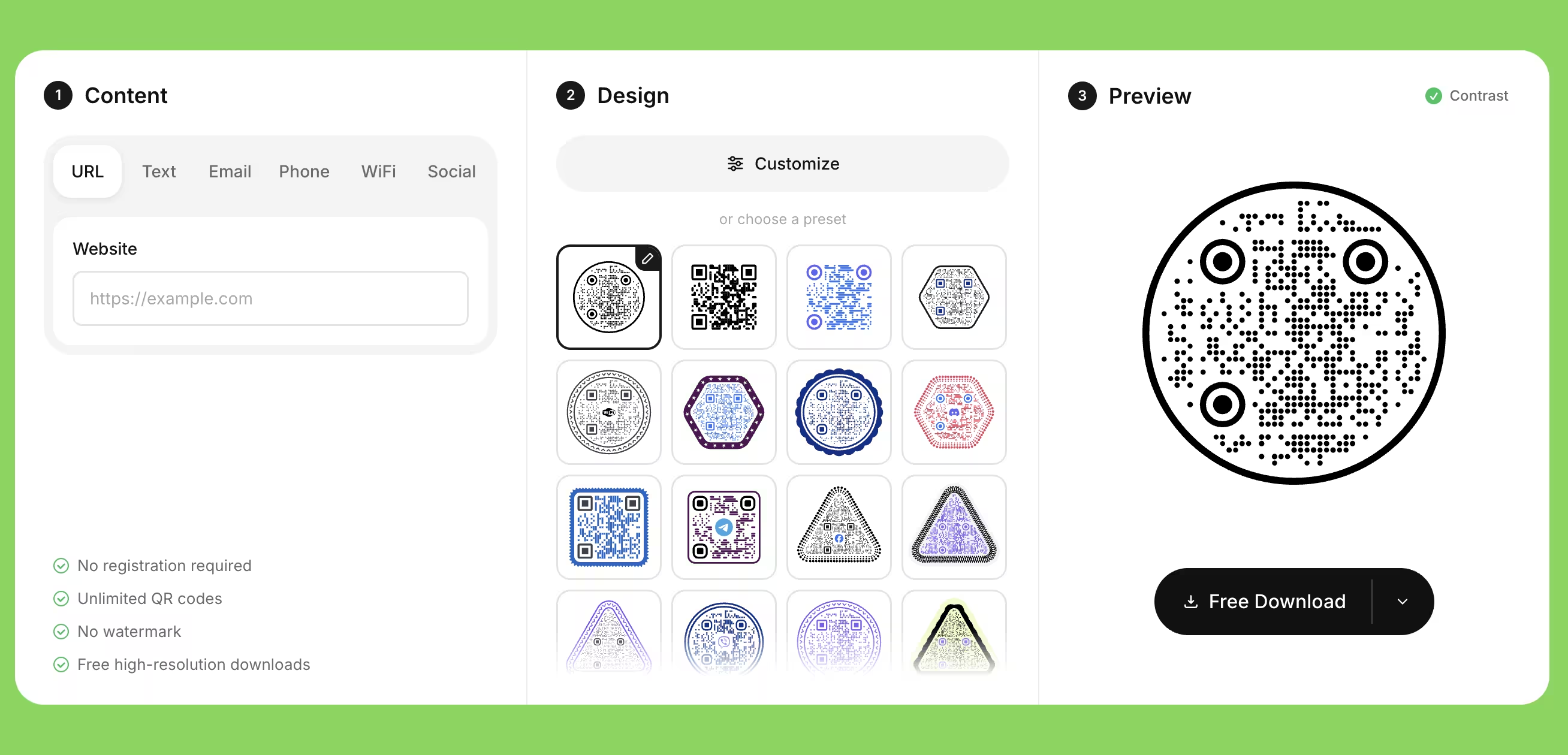
Download QR codes in all available formats without creating an account. Unitag's public generator downloads without an account too, but only as a 300-pixel PNG carrying a 100-scan limit.
KoloQRYesUnitagNoOpen Source
Inspect, modify, and self-host the source code. Unitag is proprietary hosted software.
KoloQRYesUnitagNoCustom QR Shapes
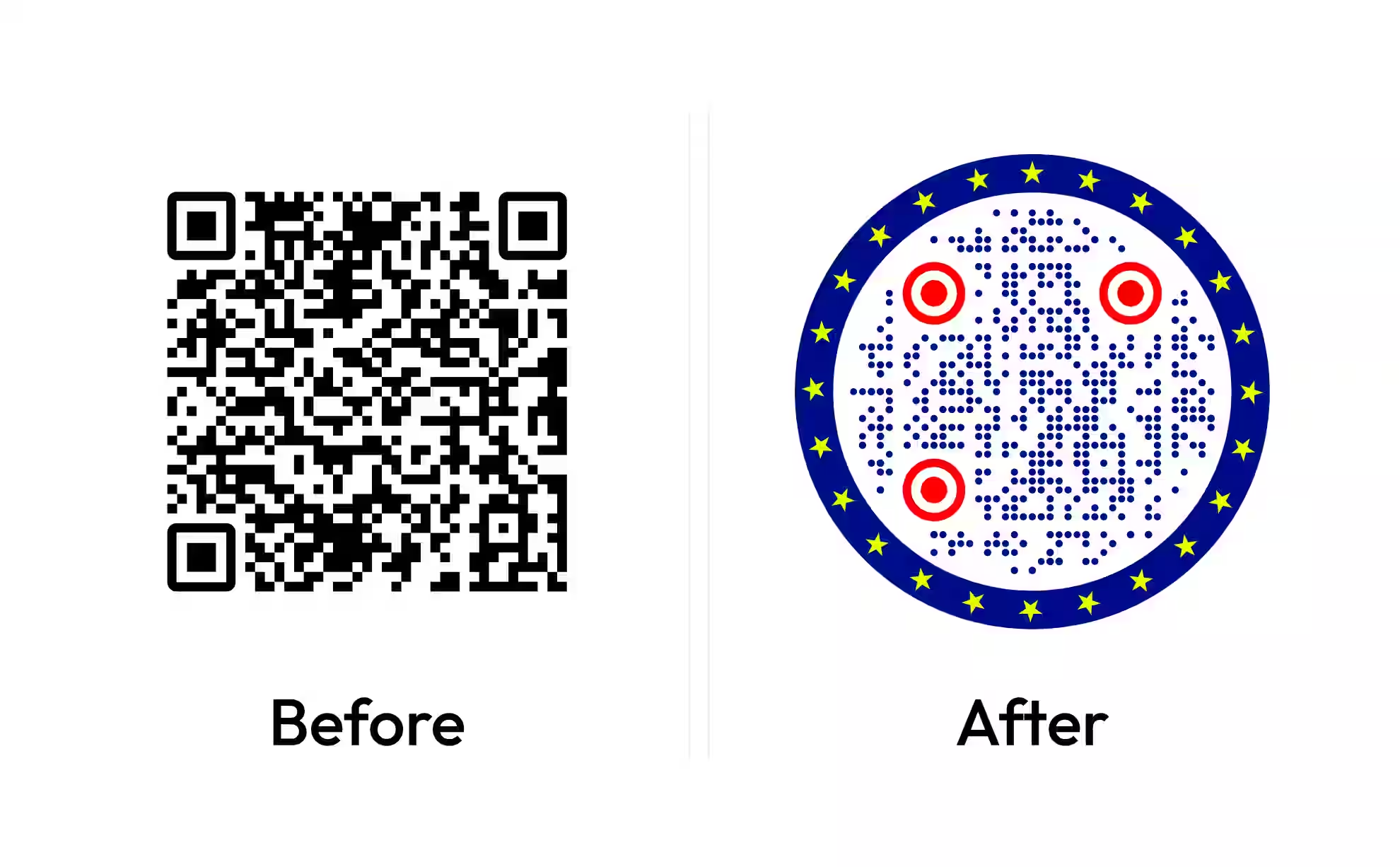
Create rectangular, circular, triangular, and hexagonal QR codes. Unitag styles the modules, eyes and colors inside a square symbol; the outline stays square.
KoloQRYesUnitagNoPremium QR Frames
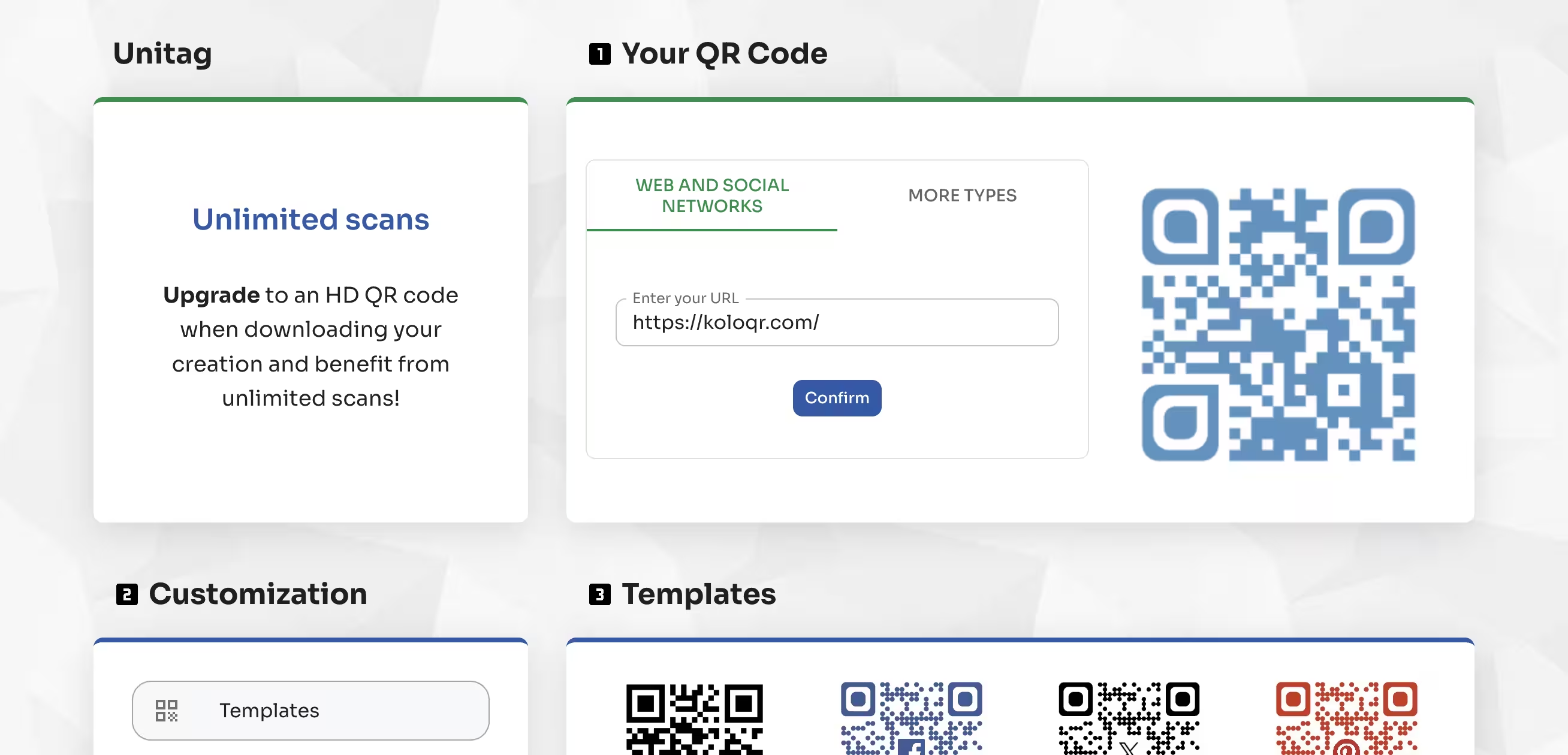
Ready-to-use designer QR frames. Unitag's public generator ships twelve design templates - classic, leaf and social network styles - rather than frames with call-to-action text.
KoloQRYesUnitagNoVector Export
Export SVG, PDF, and EPS for professional printing. Unitag's FAQ places vector PDF and SVG on the Silver plan and above, listed at £19 a month excluding VAT.
KoloQRYesUnitagPaid plansCopy to Figma
Copy QR codes directly into Figma. A Unitag code reaches a design file as a downloaded image.
KoloQRYesUnitagNoChrome Extension
Create QR codes from any webpage. Unitag publishes QR Code Generator by Unitag on the Chrome Web Store, listed at around 10,000 users.
KoloQRYesUnitagYesContrast Checker
Ensure your QR code has enough contrast for reliable scanning. Unitag's generator raises a contrast warning when the colors are too close, rather than a measured check.
KoloQRYesUnitagWarning only
What Each Tool Is Actually Built to Do
KoloQR is a design and export tool that gives the file away. Unitag is a European QR platform whose public generator is the top of a funnel. Both draw a good-looking code; what differs is what you walk away with.
KoloQR: A Free Static QR Code Generator With No Scan Limit
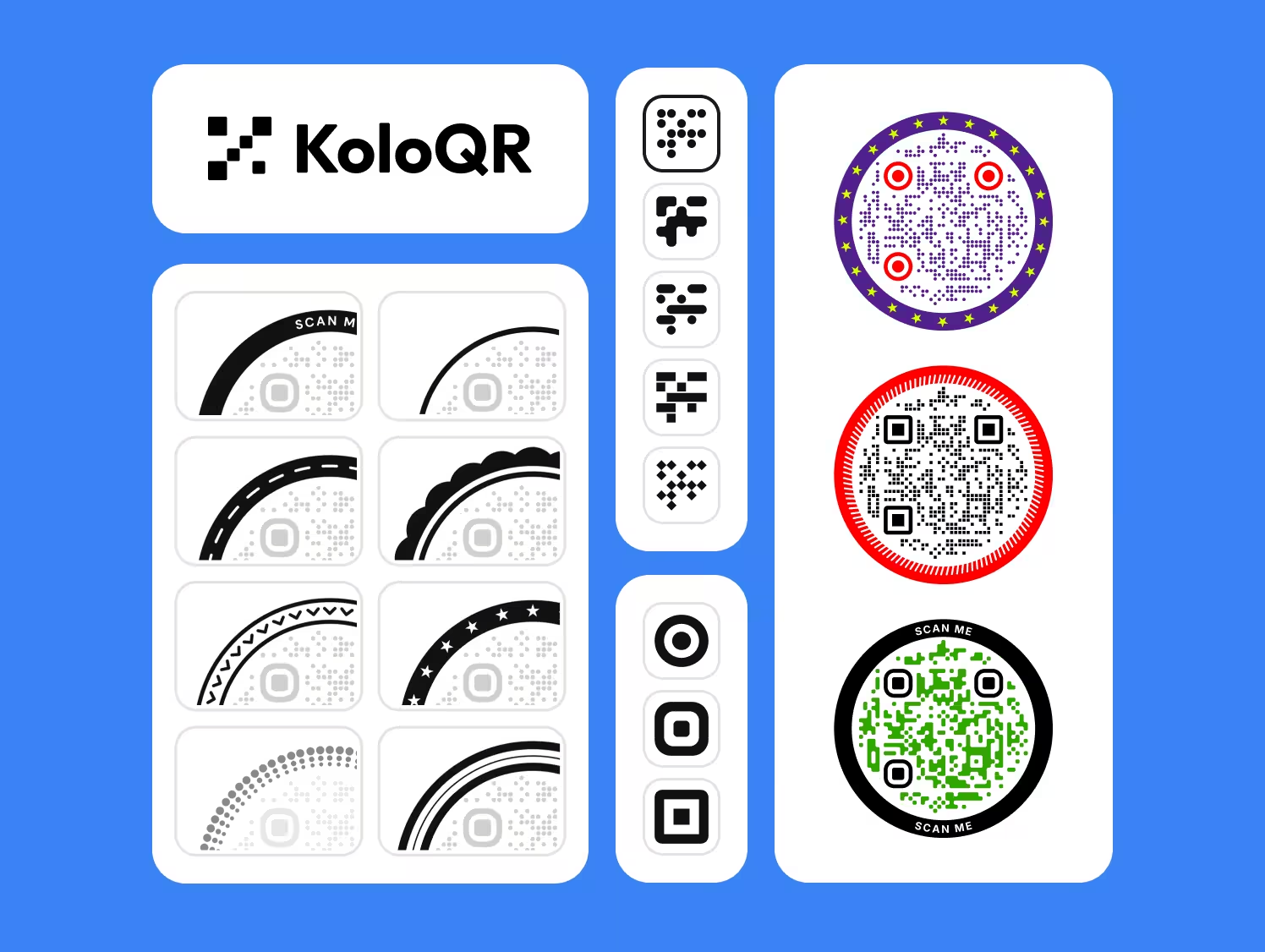
KoloQR, a free QR code generator with circular and custom-shaped QR codes, encodes the destination directly into the symbol and hands you the file. A static QR code is a code whose destination is stored in the pattern itself, so no server sits between the scan and the page. Nothing counts the scans, nothing can deactivate the code, and nothing expires: a KoloQR code works for as long as the URL it points at works.
- Every Format, No Account - KoloQR exports SVG, PDF and EPS for print and PNG for screen, all without a signup, an email address or a payment. The vector files are the ones a printer asks for, and they are not held back for a paid tier.
- Shapes Beyond the Square - KoloQR renders the whole symbol as a rectangle, circle, triangle or hexagon, not only the modules and eyes inside a square outline. A circular code fits a bottle cap, a coaster or a round table decal where a square code wastes the corners.
- No Scan Cap and No Deactivation - A KoloQR code has no counter attached to it. Print it on a thousand flyers, scan it a million times, and the thousandth flyer behaves exactly like the first - because the destination is in the pattern and KoloQR never sees the scan.
- Open Source and Self-Hostable - KoloQR's source code is published, so the generation logic can be inspected, modified or run on your own infrastructure. Teams that cannot send a destination URL to a third-party service can generate codes without one.
What Is Unitag? A European QR Platform With a Free Generator in Front
Unitag is a French-British company, trading since 2013 with offices in Toulouse and London, and its product is a QR management platform: dynamic codes that can be re-pointed after printing, scan analytics, campaign management, redirection filters, batch creation, sub-organisations and roles, EU hosting with GDPR compliance, plus GS1-compliant 2D barcodes with a Digital Link resolver for packaging. Its paid tiers were listed in August 2026 at £19, £49 and £99 a month excluding VAT for Silver, Gold and Platinum, with a Diamond tier from £4,870 a year and roughly 10% off for annual billing. For a marketing team that needs to change a destination or count scans, that is a coherent product and KoloQR is not a substitute for it.
The public generator on unitag.io is a different thing, and it is worth reading its own words. The design tools are generous for a free tool - twelve templates, module and eye styles, separate inner and outer eye colours, gradients, an image-overlay fill, a logo you can position by hand, and a warning when the colours lack contrast. The download is where it narrows. Unitag's FAQ states that with the free generator you can download the QR code in PNG at a size of 300 pixels, and that vector PDF and SVG start at the Silver plan. The generator's own download dialog says the code will be active for a maximum of 100 scans, and Unitag's lifespan FAQ says such codes are automatically deactivated and can be reactivated only by contacting support - while a separate Unitag FAQ describes free codes as static and no longer attached to the platform. Unitag also offers a one-off HD download at 13 US dollars or 12 euros including tax, which it describes as a 1200 × 1200 PNG without a time or scan limit. Before printing anything with a code from Unitag's free generator, scan it a hundred times or buy the HD download - a poster that stops working in week two costs more than either.
Create a Free QR Code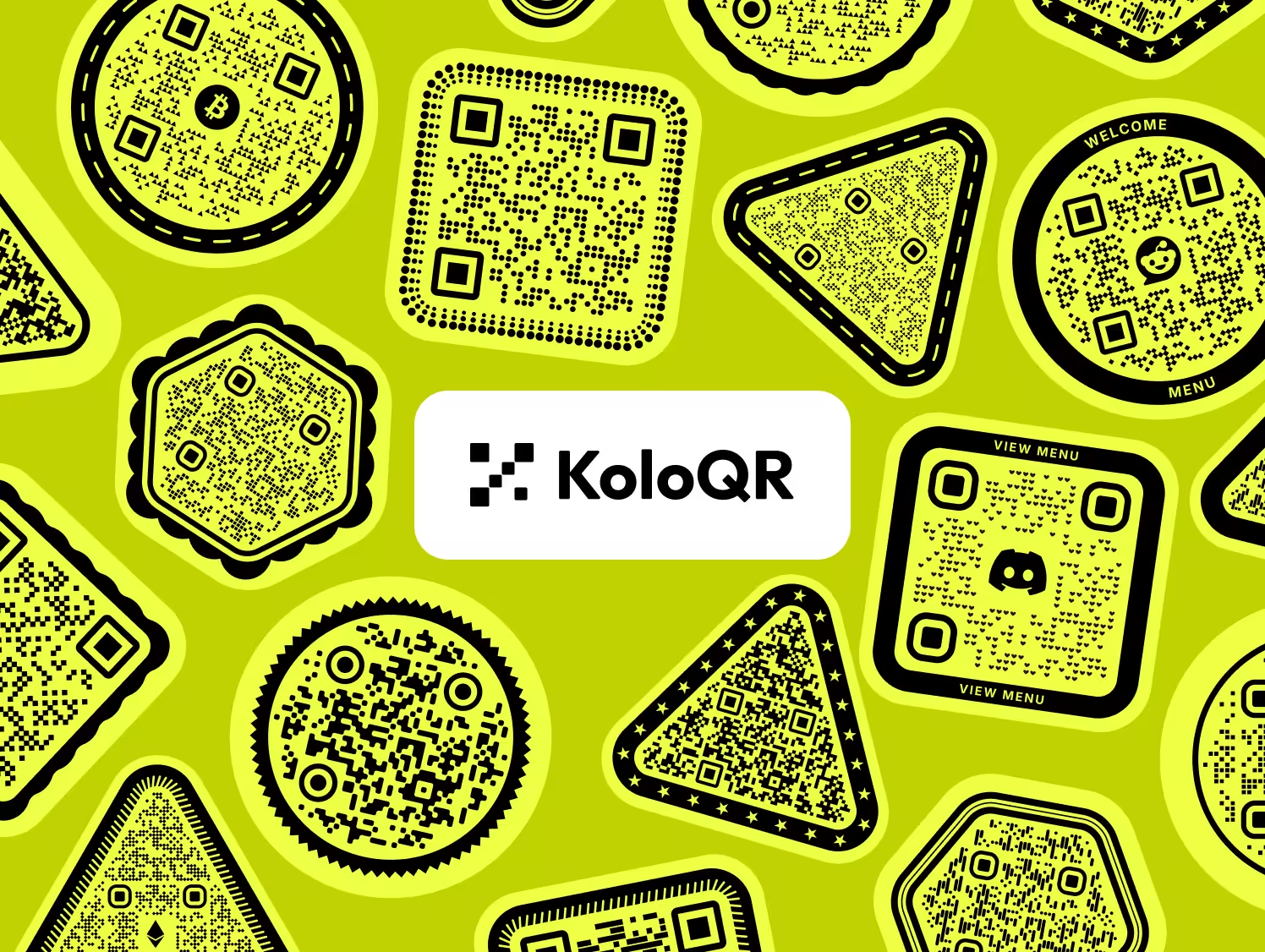
How to Choose Between a Free Generator and a QR Platform
Two questions decide this, and neither is about design tools: will the destination change after printing, and does anything limit how often the code may be scanned? These rules apply whichever tool you pick.
Read the Free Tier's Scan Limit Before You Read Its Features
A scan limit is a cap on how many times a QR code may be scanned before the provider stops serving it. Unitag's public generator states a maximum of 100 scans on the free download; KoloQR's static codes have no cap because no KoloQR server is involved in a scan. Any generator that can count your scans can also stop answering them, so find the sentence in its documentation that states the limit - and if you cannot find one, that is a question for support, not an assumption.
Decide Static or Dynamic Before You Design Anything
If the destination is fixed for the life of the printed material, a static QR code from a free generator is enough and costs nothing to maintain. If the destination will change, or scans have to be counted, buy a dynamic QR service and accept the subscription. Unitag confirms that a static code cannot be converted into a dynamic one afterwards, so choosing wrongly means reprinting.
Get an Editable Destination Without a Subscription Using Your Own Redirect
Point a static QR code at a URL on your own domain, such as example.com/menu, and configure that path as a 302 redirect to the real page. The printed code never changes; the redirect target can be edited whenever you like. This gives you the main benefit of a dynamic code without a recurring fee, and the redirect keeps working as long as you own the domain - which is not true of a platform-owned short link. The 302 matters: a browser caches a 301, so it would keep going to the old destination after you change it.
Size the Code by Scanning Distance, Not by What Fits the Layout
As a rule of thumb, a QR code needs about 1 cm of width for every 10 cm of scanning distance. Unitag publishes the same ratio as a formula - code size equals scanning distance divided by ten, which is 33 cm for a code read from 3 m - and sets its own printed minimum at 3 cm square. Treat 2 cm as the absolute floor for a short-range code and 3 cm as the safe one.
Keep the Quiet Zone Clear on Every Design
A quiet zone is the empty margin around a QR code that lets a scanner detect where the symbol begins and ends. The QR standard, ISO/IEC 18004, specifies four modules of clear space on all four sides. Decorative frames, background images and tight layouts are the most common cause of a code that scans in the design file and fails on the printed sheet.
Raise Error Correction Before Adding a Logo, Not After
Error correction is the redundancy built into a QR code that allows it to remain scannable when part of the symbol is damaged or covered. Levels L, M, Q and H recover roughly 7%, 15%, 25% and 30% of the symbol. Use level H when placing a logo in the center, keep the logo under about a quarter of the code area - Unitag's own generator warns at 30% and locks redundancy to its strongest setting when a logo is added - and test on a real phone.
Keep the Code Dark on Light, Never Inverted
Most smartphone cameras expect dark modules on a light background. An inverted code - light modules on a dark background - is legal in the standard but decoded inconsistently across scanner apps and phone models. If a dark brand background is unavoidable, place the code inside a light panel rather than inverting it.
Export Vector for Anything That Goes to Print
SVG, PDF and EPS are vector formats that stay sharp at any size; PNG is a raster format that softens the module edges when scaled up. A 300-pixel PNG is roughly 2.5 cm at 300 DPI, which is why a free PNG from any generator is a screen file rather than a print file. Send the printer a vector, or generate the PNG at final physical size and at least 300 DPI.
Print the Destination in Text Beside the Code
A short readable URL next to the QR code makes the content reachable for anyone whose camera fails, whose phone is old, or who simply does not scan codes. It also rescues the print run if the code itself is ever deactivated. A QR code should always be the fast path to the content and never the only path - this is an accessibility requirement, not a nicety.
Test the Printed Code, on Paper, Before the Full Run
Print one copy at final size on the final material and scan it with at least two phones, one iOS and one Android, at the real distance and under the real lighting. Gloss lamination under a downlight and ink spread on uncoated stock are the two failures that never appear on screen. A single test print costs less than a reprint of the whole job.
Questions? Answered
Unitag says so in three places. The generator's download dialog states that the code will be active for a maximum of 100 scans, the /qrcode FAQ says free codes stop working after being scanned a hundred times, and the lifespan FAQ says they are then archived and can be reactivated by contacting support. A fourth Unitag FAQ describes free codes as static and no longer attached to the platform. Is Unitag free? quotes each passage in full. Test before you print.
KoloQR is free with no account, no watermark, no scan limit and no paid tier gating the formats: SVG, PDF, EPS and PNG all download without signing up. The trade-off is that KoloQR generates static QR codes only. The destination is encoded in the symbol, so it cannot be changed after printing and no scans are recorded.
No. Unitag's FAQ states that high-resolution vector output - PDF, SVG and PNG or JPEG up to 3000 px - starts at the Silver plan, listed at £19 a month excluding VAT in August 2026. The free public generator gives a PNG 300 pixels wide, and the one-off HD purchase gives a 1200 × 1200 PNG rather than vector. KoloQR exports SVG, PDF and EPS with no account.
In August 2026 Unitag listed Silver at £19, Gold at £49 and Platinum at £99 a month excluding VAT, with a Diamond tier from £4,870 a year and about 10% off for annual billing. Unitag shows prices in pounds, euros or dollars depending on your region. A one-off HD download of a single code was 13 US dollars or 12 euros including tax, and GS1 and API plans started at £12 a month.
A 300-pixel PNG is a fixed grid of pixels: printed at 300 DPI it measures about 2.5 cm, and enlarging it softens the module edges until scanners struggle. SVG, PDF and EPS are vector formats that describe the modules as shapes, so the same file stays sharp as a business card QR code and as a 3 m banner. For anything going to a printer, ask for vector.
No. KoloQR generates static QR codes and has no analytics layer, no dashboard and no account, so nothing is recorded on our side. If you need scan counts, either use a dynamic QR platform such as Unitag, or point a static code at a URL on your own site and read the visits in your existing web analytics. The second option gives you page visits rather than true scan counts.
No. Unitag's generator customizes what is inside the symbol - module style, eye style, separate inner and outer eye colors, gradients, an image-overlay fill and a logo - but the symbol outline stays square. KoloQR renders the whole code as a rectangle, circle, triangle or hexagon, which matters when the code has to sit inside a round sticker or a hexagonal label.
Unitag states that dynamic codes remain functional if a subscription expires but you lose control of them - no editing, no analytics, no downloads - and that codes created in the client dashboard are subscription-dependent, with a buy-back offer available through support. Static codes created in the console keep working, since the destination is in the symbol. Confirm the current terms before you commit.
Use a free static code if the menu lives at a stable URL, and point it at your own domain so you keep the ability to redirect it later. Choose Unitag or another dynamic platform if you run seasonal campaigns, need per-location scan data, or manage codes across many sites. A table tent rarely justifies a subscription; twenty tracked campaign codes usually do.
The four usual causes are a quiet zone eaten by a frame or background, a raster file enlarged past its resolution, ink spread on uncoated paper closing the gaps between modules, and gloss lamination throwing a reflection into the camera. A fifth, specific to free tiers, is a scan limit reached after distribution. Print one copy at final size on the final stock and test it before approving the run.
Make a Print-Ready QR Code Now, for Free
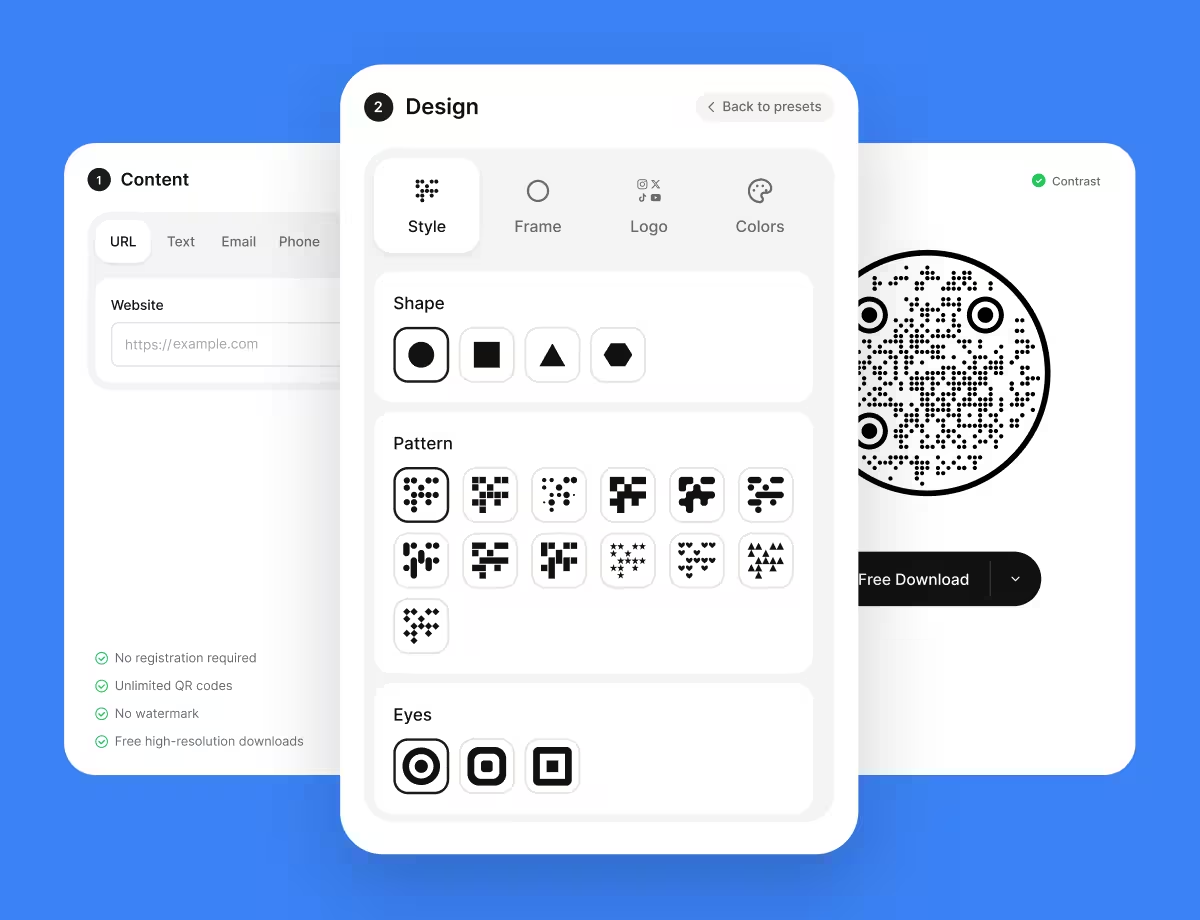
If the destination is not going to change, KoloQR gives you the finished file in the browser: pick a shape, set the colors, add a logo, check the contrast, download SVG, PDF, EPS or PNG. No account, no watermark, no scan counter and no expiry date on the code.
If you need to re-point a code after it is printed, count scans by device and country, run GS1 Digital Link on packaging, or keep everything on EU-hosted infrastructure with GDPR paperwork behind it, Unitag is a real platform for that and we would rather say so than sell you the wrong tool. A middle path worth trying first: generate a free static code here, point it at a redirect URL on your own domain, and keep the ability to change the destination without a subscription. If the campaign later needs per-code analytics, you have lost nothing by starting free.
Create Your QR CodeKeep Exploring
Pages that pick up where this one leaves off - the same setting, the same kind of code, or the next thing worth deciding.
Do QR Codes Expire? The Pattern Never Does
The pattern never expires, and four things behind it do. Which one failed, how to tell them apart, and which of them you can fix without reprinting.
QRCode Monkey Is Genuinely Free, and Its PDF Is Not Vector
QRCode Monkey's free tier is real, and two things in it are not what they look like - the upsell inside the editor, and a PDF export that turns out to be a picture of a QR code rather than a vector one.
QR Tiger Is Free Twice Over, and Only One of Them Is Really Free
QR Tiger's free plan is two different offers wearing one label: unlimited static codes that cost nothing and outlive the company, and three dynamic codes capped at 500 scans that are paid for by the person holding the phone.
Static or Dynamic? Decide It Before Anything Is Printed
The difference is where the destination lives, and price, analytics and every failure mode follow from it. Four questions that settle which one to print.
A Free QR Tiger Alternative, No Signup
A design-first, open-source QR generator compared with a campaign-focused tracking platform. See which one fits your project.
KoloQR vs QR Batch
A free design tool that makes one QR code at a time, compared with a paid production line that turns a spreadsheet into thousands of them. The deciding factor is how many different codes you need, not how good any one of them looks.
Why KoloQR?
- Create QR codes for websites, menus, Wi-Fi, PDFs, and business cards
- Customize colors, logos, and unique shapes
- Download high-quality PNG and SVG files
- Built for both print and digital