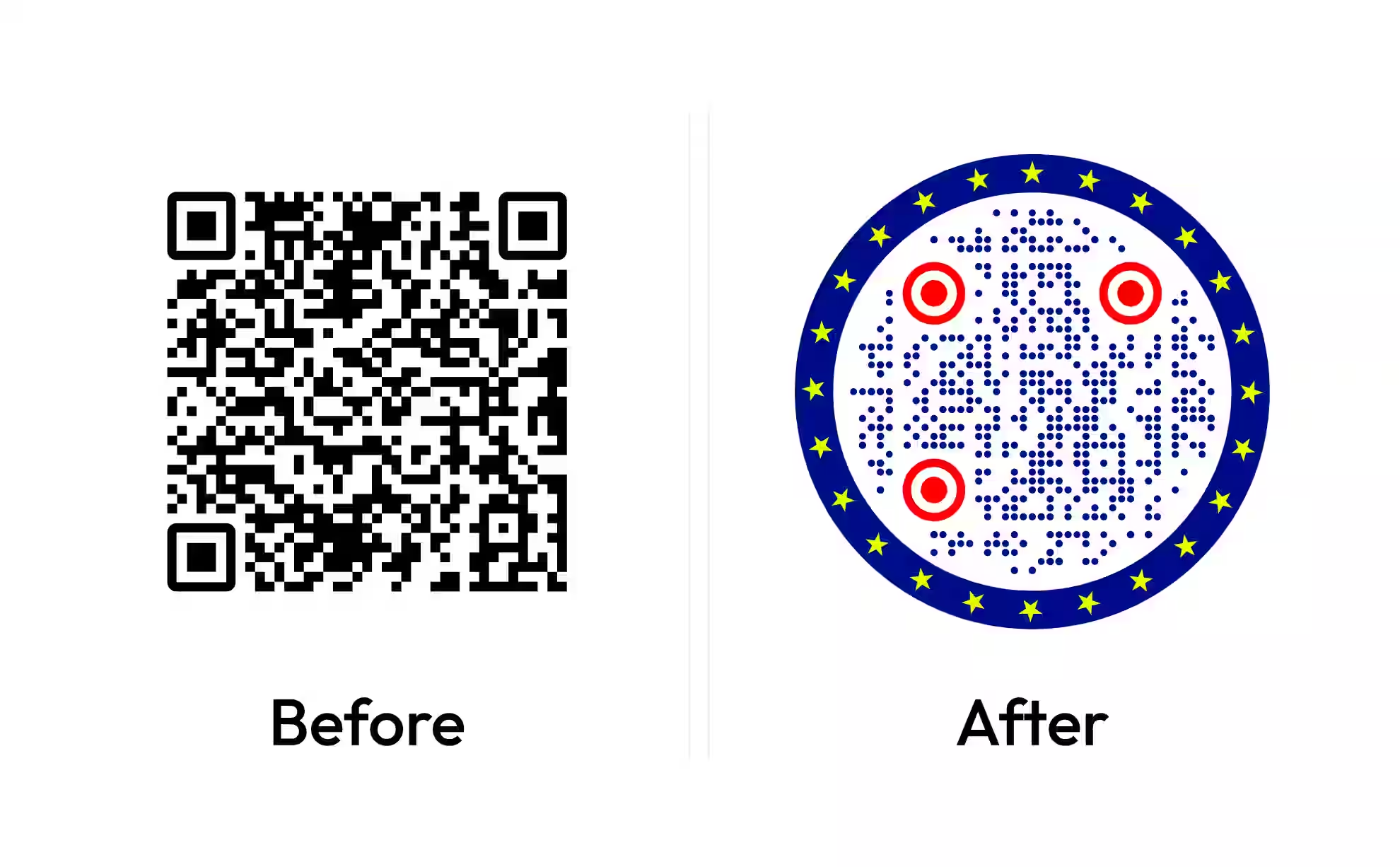
Unitag's Free QR Codes Stop Working After 100 Scans
by KoloQR TeamIndustry
Unitag's public generator is genuinely free to use, needs no account and downloads a styled PNG on the spot. What it does not download is a permanent code. Unitag's own FAQ states it in one sentence: "If a non-HD QR Code is created via our public generator, it is limited to 100 scans. Afterwards, they are automatically deactivated." KoloQR read the generator page, the FAQ and both pricing pages on 31 August 2026. This is what the free tier really gives you, why a free code can be switched off at all, and what the alternative costs.
Key Points
- Unitag's free codes are metered by scans, not by time. Its FAQ: "If a non-HD QR Code is created via our public generator, it is limited to 100 scans. Afterwards, they are automatically deactivated."
- The generator page states the same limit in its own FAQ block - "Free QR codes created through the generator will stop working after being scanned a hundred times" - beneath a banner that reads "Free instant download · Easy customisation · Lifetime validity".
- A code that can be deactivated is a code that redirects. Unitag reserves the word static for its console: "static QR codes are only available from our console... They do not use any redirection on our platform and hence are completely independent of our services once downloaded."
- The free file is small. "With our free generator, you can download the QR Code in PNG at a size of 300 pixels" - which is 2.54 cm at 300 dpi, below the 3 cm minimum print size Unitag itself recommends on the same page.
- Read off unitag.io/pricing/qr-plans on 31 August 2026: Silver £19, Gold £49 and Platinum £99 a month excluding VAT, with Diamond starting at £4,870 a year. Vector exports - PDF and SVG - start at Silver.
Is Unitag Free? The Short Answer
Unitag's public QR code generator is free to use and free to download from, with no account and no watermark, and the code it gives you stops working after 100 scans. Both halves of that sentence come from Unitag's own site, and the second one is the half most people find out about later.
The generator page advertises the offer in three words each: "Free instant download", "Easy customisation", "Lifetime validity". The first two are accurate. The third is answered in the FAQ directly below it: "Free QR codes created through the generator will stop working after being scanned a hundred times. HD QR codes are valid forever, no matter how many times they are scanned, and will continue to function indefinitely."
So lifetime validity is a property of the paid HD download, not of the free one, and the two sit within a screen of each other on the same page. Nothing here is hidden - Unitag publishes the limit in at least two places - but the reader who takes the banner at face value and prints a thousand flyers has made a reasonable mistake with an unreasonable cost.
The number to hold on to is 100. That is not 100 people, or 100 days: it is 100 scans, after which the code is deactivated at Unitag's end and the person holding the phone gets an error page instead of your website.
A Free Code That Can Be Switched Off Is Not a Static Code
A QR code can only be deactivated remotely if it points at the vendor rather than at your destination, and Unitag is unusually clear about which of its products does which. Its FAQ on lifespan separates them into three cases - static codes, public generator codes, and dynamic codes - and puts the free generator in the middle.
On its static codes: "These QR Codes directly encode the data you entered (website address, phone number, business card, and so on). They do not use any redirection on our platform and hence are completely independent of our services once downloaded. They will always contain the data you entered when creating the code, and their lifespan is unlimited!" The same answer notes that "static QR codes are only available from our console" - the paid product, not the free generator.
That is the definition doing the work on this page. A static QR code is a code that carries its destination inside the pattern itself, so nothing has to stay online for the code to keep working. A dynamic QR code is a code that encodes a link to the provider's server, which forwards each scan to wherever the destination currently points. Only the second kind can be counted, capped or switched off, because only the second kind asks a server for permission on every scan.
Read against those two definitions, the free Unitag code behaves as the second kind with the features of neither: it can be deactivated like a dynamic code, and it cannot be edited like a static one. That is a defensible way to run a free tier - the scan counter is what makes it a demonstration rather than a giveaway - and it is worth knowing before rather than after the print run.
The comparison across free tiers is instructive here, because free means something different at every one. QRCode Monkey gives away a genuinely static file and sells a separate product. ME-QR gives away dynamic codes and charges the person scanning by showing them an advertisement. QRFY gives away seven static payload types and puts the other eighteen behind a seven-day trial. Unitag gives away a hundred scans.
The Free Download Is 300 Pixels, Which Is 2.5 cm at 300 dpi
Unitag caps the free download by resolution as well as by scans, and publishes both numbers: "With our free generator, you can download the QR Code in PNG at a size of 300 pixels" and, for the paid one-off, "An HD QR Code will be sent in a PNG format, size 1200*1200px."
On the same page, Unitag gives print advice that its own free file cannot satisfy at standard print resolution: "To be sure that your QR Codes are readable, do not print them in less than 3cm square (1.2 inches)." A 300-pixel image at 300 dpi is exactly one inch - 2.54 cm - so the free download lands below Unitag's own floor unless you drop to about 254 dpi, which is where module edges start to soften.
| Download | Pixels | Width at 300 dpi | Available on |
|---|---|---|---|
| Free generator PNG | 300 × 300 | 2.54 cm | Free, no account |
| HD QR code PNG | 1200 × 1200 | 10.16 cm | One-off paid download |
| Vector - PDF, SVG - and PNG/JPEG to 3000 px | No fixed ceiling | Any size | Silver plan and above |
The same sum runs in either direction, and our DPI calculator does it for any printed width: give it the width you need and it returns the pixels. This matters more than the scan cap for anything larger than a business card. A 300-pixel PNG enlarged to a table tent is a blurred code, and blurred module edges are one of the ordinary causes of a code that reads slowly in good light and not at all in bad - alongside low contrast, a crowded quiet zone, and printing below the minimum size for the amount of data.
Unitag's own line on why vector matters is the honest one, and it names the tier: "Starting from the Silver plan, you have access to QR Code in high-resolution: (vector-based graphic: PDF, SVG, PNG/JPEG up to 3000px)." A vector file is an image made of coordinates and curves rather than pixels, so it can be enlarged to any size without losing sharpness, which is the difference between SVG and PNG in one sentence.
What to Do If You Have Already Printed a Free Unitag Code
Nothing about a printed code can be fixed by reprinting the same code, because the limit lives on Unitag's server rather than in the pattern. The sequence below is what is worth doing this week rather than after the hundredth scan.
- Scan Your Own Code and Read Where It Goes. Point a phone at it and look at the URL your browser lands on before it forwards you. If it starts on a Unitag domain rather than your own, the code is a redirect and the 100-scan rule applies to it.
- Count What Is Already Out There. One hundred scans is roughly three a day for a month, or one per table over a busy weekend. Estimate honestly rather than optimistically, because the failure is silent - nothing warns you, and the first sign is a customer saying the code is broken.
- Generate a Replacement That Nobody Can Switch Off. Encode the destination directly, from any generator that produces genuinely static codes - Unitag's own console does, and so does the KoloQR generator, which draws the code in your browser and never sees the payload.
- Point It at a URL You Own. Encode a short path on your own domain and redirect from there. The printed pattern then never has to change again, and the destination stays editable forever because the redirect is yours rather than a vendor's.
- Print at 300 dpi and Test the Real Piece. Export vector where you can, print at the size the job needs, and scan the printed sheet with two different phones before the run. Our QR code validator covers the case where no phone is to hand.
What Unitag Charges, and What It Is Good At
Unitag sells to businesses rather than to individuals, and the pricing reflects it. Its plans page lists Silver at £19 a month, Gold at £49 and Platinum at £99, all excluding VAT, with a Diamond tier starting at £4,870 a year on a custom contract and a 10% discount for paying yearly.
| Plan | Monthly, excl. VAT | Data history | Batch creation |
|---|---|---|---|
| Silver | £19 | 2 weeks | 25 codes per batch |
| Gold | £49 | 1 year | 150 codes per batch |
| Platinum | £99 | 3 years | 8,000 codes per batch |
| Diamond | From £4,870 a year | Unlimited | 15,000 codes per batch |
What every tier includes is the part worth naming, because it is unusual: "Unlimited QR Codes", "Unlimited scans, with no per-scan fees at any volume", dynamic codes, scan analytics and EU-hosted infrastructure. A platform that does not meter scans at all is rarer than it should be, and it removes the single most common way a QR campaign fails - hitting a ceiling in the middle of the thing you printed it for.
Unitag's other genuine strength is regulatory rather than creative. It offers GS1-compliant 2D barcodes with a Digital Link resolver aimed at Digital Product Passport work, an API for integrators and printers, EU hosting with GDPR framing, and a partner programme for white-label resale. For packaging and retail compliance work, that is a different market from the one most QR generators compete in, and Unitag is a serious participant in it.
None of that is available on the free generator, which is the honest summary of this page: Unitag's free tier is a sample of a business platform, not a free tool with a business platform attached.
When Unitag's Free Generator Is the Right Answer
Unitag's free generator is the right tool when the code will be scanned a handful of times, or when you want to see a design before deciding anything. It styles well, it downloads instantly, and it asks for nothing.
- A mock-up or a design review. Free, instant, no account, and the 100-scan ceiling is irrelevant to a slide.
- A code for one meeting or one desk. A hundred scans is plenty when you know who is scanning.
- Anything printed for the public. Do not use the free code. It will be deactivated mid-campaign, and the printed piece cannot be corrected.
- Anything larger than a business card. The free download is 300 pixels, which is 2.54 cm at 300 dpi. Vector export starts at the Silver plan.
- GS1, Digital Link or packaging compliance work. That is what Unitag is actually built for, and the free generator has nothing to do with it.
KoloQR, a free QR code generator with circular and custom-shaped QR codes, differs from Unitag's free tier in the one respect this page is about: the codes it produces are static, so there is nothing to deactivate and no counter running. It needs no account, adds no watermark, exports SVG and PNG, and draws the code in your browser rather than on a server. It is also open source, so its behaviour can be read rather than inferred.
It replaces nothing on Unitag's paid side. KoloQR has no dynamic codes, no analytics, no GS1 Digital Link resolver, no API and no team accounts, and Unitag's unmetered scanning and EU hosting are real advantages for the work it is aimed at. If editable destinations, packaging compliance or campaign reporting are the requirement, Unitag is the better answer, and the side-by-side comparison sets out feature by feature where each one leads.
Make Your QR Code
Free, with no account and no watermark. Choose a shape, add a logo, check the contrast, and export SVG, PDF, EPS or PNG - a static code with no subscription behind it.
Generate QR CodeQuestions? Answered
The generator is free to use and free to download from, with no account required. The code it produces is not permanent: Unitag states that "if a non-HD QR Code is created via our public generator, it is limited to 100 scans. Afterwards, they are automatically deactivated." Free covers the file, not the lifetime of the link.
Most likely it reached 100 scans. Codes from Unitag's public generator are deactivated automatically at that point, which is a limit on Unitag's server rather than a fault in the printed pattern. Reprinting the same code will not help; you need a genuinely static code, or a Unitag subscription, to replace it.
It depends which kind. Free public-generator codes are deactivated after 100 scans. Paid HD codes are, in Unitag's words, "valid forever, no matter how many times they are scanned". Static codes made in Unitag's console encode the data directly, use no redirection, and have an unlimited lifespan - but the console is the paid product.
300 × 300 pixels, in PNG. At 300 dpi that is 2.54 cm across - just under the 3 cm minimum print size Unitag itself recommends. The paid HD download is 1200 × 1200 pixels, about 10 cm at 300 dpi, and vector formats such as PDF and SVG start at the Silver plan.
Read off its plans page on 31 August 2026, excluding VAT: Silver £19 a month, Gold £49, Platinum £99, and Diamond from £4,870 a year on a custom contract. Paying yearly takes 10% off. Every plan includes unlimited QR codes and unlimited scans with no per-scan fees, which is unusual in this market.
Only a dynamic one, and only with a subscription. Unitag: "QR Code updates are possible for Dynamic URL QR Codes, and if you subscribe to our Live account." A free public-generator code cannot be edited and cannot be topped up - it can only be replaced, which means reprinting whatever it was printed on.
No. Nothing on Unitag's site describes a watermark on the image or an advertisement shown to the person scanning, which is a genuine point in its favour next to free tiers that do. The free tier's cost is the 100-scan ceiling and the 300-pixel file, not branding on your artwork.
It behaves as a redirect. Unitag reserves the word static for console codes that "do not use any redirection on our platform", and a code that can be automatically deactivated after 100 scans is necessarily one that asks Unitag's server on every scan. It is a metered redirect with none of the editing a dynamic code normally buys.
Unitag is a QR code and Digital Link platform trading since 2013, with offices listed in London and Toulouse and EU-hosted infrastructure. Its business is GS1-compliant 2D barcodes, packaging and campaign analytics for brands rather than one-off codes, which is the context the free public generator sits in.
Keep Exploring
Pages that pick up where this one leaves off - the same setting, the same kind of code, or the next thing worth deciding.
Do QR Codes Expire? The Pattern Never Does
The pattern never expires, and four things behind it do. Which one failed, how to tell them apart, and which of them you can fix without reprinting.
QRCode Monkey Is Genuinely Free, and Its PDF Is Not Vector
QRCode Monkey's free tier is real, and two things in it are not what they look like - the upsell inside the editor, and a PDF export that turns out to be a picture of a QR code rather than a vector one.
QR Tiger Is Free Twice Over, and Only One of Them Is Really Free
QR Tiger's free plan is two different offers wearing one label: unlimited static codes that cost nothing and outlive the company, and three dynamic codes capped at 500 scans that are paid for by the person holding the phone.
How to Create a QR Code in Canva and Export It So It Still Scans
The six steps to make a QR code inside a Canva design, the export setting that decides whether it prints sharp, and how to bring in a circular or vector code when Canva's square one is not enough.
KoloQR vs Unitag
A free open-source generator that hands you a print-ready vector file, compared with a European QR platform whose free download is a 300-pixel PNG limited to 100 scans. The deciding factor is whether the code you print has to survive its hundredth scan.
Static or Dynamic? Decide It Before Anything Is Printed
The difference is where the destination lives, and price, analytics and every failure mode follow from it. Four questions that settle which one to print.
Why KoloQR?
- Create QR codes for websites, menus, Wi-Fi, PDFs, and business cards
- Customize colors, logos, and unique shapes
- Download high-quality PNG and SVG files
- Built for both print and digital