QRCode Monkey Is Genuinely Free, and Its PDF Is Not Vector
by KoloQR TeamIndustry
QRCode Monkey's free generator is free in the way it says it is: no account, no watermark, no expiry, no scan limit, and commercial use allowed, all stated on its own site. What is not obvious is where the money is, and what is in the files. KoloQR downloaded the same QR code in all four formats on 21 August 2026 and opened them: the SVG and the EPS are true vector files that carry the colours, the round modules and the logo, while the PDF is a single raster image inside a PDF page. That difference decides how large you can print, and it is the one thing on this page worth checking before a print run.
Key Points
- QRCode Monkey's own FAQ states that the codes are free for any purpose including commercial use, that they "do not expire and will work forever", and that "There is no limit and the created QR code will work forever."
- Downloading needs no account. The download button is a plain web request to the tool's public API, and it returned the file to KoloQR on 21 August 2026 with no login, no cookie and no watermark on the code.
- The money is in a second product. The note under the download buttons reads: "The created static QR code is 100% free but if you need scan statistics, flexible editability and more features then have a look at our QR Code Generator for professionals."
- Measured by KoloQR on 21 August 2026: of the four download formats, the .svg and the .eps contain real vector paths, and the .pdf contains one raster image on a blank page - 2320 × 2320 pixels at the size slider's maximum, which is roughly 19.5 cm wide at 300 dpi.
- The permanent cost of a free static code is that it can never be edited. QRCode Monkey states it plainly: "You just can't edit the content of the QR Codes again." If the destination changes, the printed run is what pays.
Is QRCode Monkey Free? The Short Answer
Yes. QRCode Monkey's static QR code generator is free to use, needs no account, adds no watermark, and produces codes that never expire and are not limited by scans. Its own site says so in four separate places, and the behaviour matches the copy: KoloQR generated and downloaded codes from it on 21 August 2026 without signing in.
The claims are worth quoting exactly, because they are the answer to most of the question. On commercial use: "Yes, all QR codes you created with this QR generator are free and can be used for whatever you want." On expiry: "They do not expire and will work forever! QR Codes created with QRCode Monkey are static and do not stop working after a certain time." On scans: "There is no limit and the created QR code will work forever."
None of that depends on trust, because none of it depends on QRCode Monkey. A static QR code is a code that carries its destination inside the pattern itself, so nothing has to stay online for the code to keep working. Once the file is downloaded, the company could close tomorrow and every code it ever produced would keep resolving, because the phone reads the URL out of the pattern rather than asking a server for it.
That is the structural reason a free static generator can promise "forever" and mean it, and the reason the same promise from a free dynamic plan means something much weaker. Unitag's free generator is the sharpest case: its codes are deactivated after 100 scans. A dynamic code points at the provider's short link first and at your page second, so its lifetime is the lifetime of the account behind it - which is the subject of the note on what a dynamic QR code subscription actually buys.
Where the Money Is, and Where the Tool Says So
QRCode Monkey earns from a second, paid product rather than from the generator. The line printed under the download buttons is unambiguous: "The created static QR code is 100% free but if you need scan statistics, flexible editability and more features then have a look at our QR Code Generator for professionals." Everything free stays free; the two features most people eventually want are the ones behind the signup.
The upsell is placed inside the editing flow rather than around it, and one instance is easy to misread. Beside the URL field sits what looks like a toggle switch labelled "Statistics and Editability". It is an image file named toggle-switch-placeholder.png, and clicking it opens a signup modal - there is nothing to switch on. The download dialog carries further panels, marked "Ad" in the page's own markup, one of which reads "Do more with your QR Codes with Bitly".
Those signup links are checkable from the page source. They point at app.qr-code-generator.com and at bitly.com, and they carry the parameters user_source=qrcm and placements named logo, more and statistics - the three points in the editor where a free user is most likely to want the paid feature. QR Code Generator PRO is run by Egoditor GmbH, which Bitly announced it had acquired on 1 December 2021, describing Egoditor as the provider behind qr-code-generator.com.
This is an ordinary arrangement and worth naming without drama: the free tool is the top of a paid funnel, and being the top of a funnel is what keeps it free and unmetered. The practical consequence is small but real - know which buttons stay on qrcode-monkey.com and which ones start an account somewhere else.
| What you want | Where it lives | What it costs |
|---|---|---|
| A styled static code, downloaded | qrcode-monkey.com | Free, no account |
| PNG, SVG, PDF and EPS export | qrcode-monkey.com | Free |
| A logo on the code | qrcode-monkey.com | Free, up to about 30% coverage |
| Scan statistics | QR Code Generator PRO signup | A paid plan on another site |
| Editing the destination after printing | QR Code Generator PRO signup | A paid plan on another site |
| Bulk creation and editing | QR Code Generator PRO signup | A paid plan on another site |
What Is Actually Inside the Four Downloads
KoloQR downloaded the same QR code from QRCode Monkey in all four formats on 21 August 2026 and opened the files. The .svg and the .eps are true vector files carrying the custom colours, the round module shape and the logo. The .pdf is not: it is a single raster image placed on an otherwise empty PDF page, 2320 × 2320 pixels at the size slider's maximum of 2000.
A vector file is an image made of coordinates and curves rather than pixels, so it can be enlarged to any size without losing sharpness. That is the entire reason a printer asks for one, and it is why the distinction below matters more than any feature on any pricing page. The difference between SVG and PNG is the same difference, in the two formats most people meet first.
| Download | What the file contained | Scales without loss? |
|---|---|---|
| PNG | A raster image, 2320 × 2320 pixels at the slider's maximum | No |
| SVG | Vector paths - 234 of them in our test file - with the colours and logo | Yes |
| EPS | Vector paths with the colours and logo, as PostScript curves | Yes |
| One embedded 2320 × 2320 pixel image on a blank page | No |
The method is worth stating so the result can be disputed or confirmed. The site's download button requests api.qrcode-monkey.com/qr/custom with the chosen format, size and design settings; the same request was made four times, once per format, for one URL with a circular module style, two custom colours and a logo from the built-in gallery. The SVG and EPS were read as text and contain drawing commands; the PDF was parsed and contains a single image object with an 8-bit RGB colour space.
Two of those findings contradict QRCode Monkey's own documentation, in opposite directions. The site states that "The logo and design settings currently only work for .png and .svg files" and that the PDF and EPS "only support classic QR codes without the design and logo options" - but the EPS we downloaded carried the design and the logo in full. The site also describes PDF as one of the "vector formats" it offers, and the PDF we downloaded was a picture. Documentation drifts behind software; the file on your disk is the thing to check.
One caveat on the good news: the logo tested was one of the built-in gallery marks, which are vector to begin with. A logo you upload as a PNG or JPG stays a raster picture inside whichever file it lands in, because nothing can convert a photograph into curves on the way out.
Why a Raster PDF Matters at Poster Size
A raster PDF sets a hard ceiling on print size that a vector one does not have. QRCode Monkey's largest export is 2320 pixels across, which is about 19.5 cm at 300 dpi, about 39 cm at 150 dpi, and no larger than that without visible softening at the edge of every module. For a business card, a menu or a flyer this is irrelevant; for a shop window, a banner or an exhibition panel it is the whole problem.
The trap is that the PDF opens at a size that looks generous. The page in the file we measured is 2320 points across - roughly 82 cm - with a 2320-pixel image filling it, which works out to 72 dpi at full page size. A designer who places that PDF at its natural size and sends it to print has placed a 72 dpi image, and nothing in the file warns them. Our DPI calculator turns the same arithmetic around: enter the printed width you need and it gives the pixels required.
Blurred module edges are not merely ugly. A scanner decides where each module begins and ends, and soft edges at a small print size are one of the ordinary causes of a code that reads slowly in good light and not at all in bad - alongside low contrast, a crowded quiet zone, and printing below the minimum size for the amount of data.
- Download the SVG, Not the PDF. Choose the .svg download for anything that will be enlarged, and treat the .pdf as a convenience format for viewing. The SVG is the file that contains the actual shapes, and it is the one QRCode Monkey itself recommends for further editing.
- Push the Size Slider to Maximum First. The slider runs from 200 to 2000 pixels and governs the raster exports. It costs nothing to move it to 2000 before downloading, and it is the difference between a PNG that survives a poster and one that does not.
- Open the File Before Sending It Anywhere. Open the SVG or EPS in Illustrator, Inkscape or Affinity and zoom in until the modules fill the screen. Vector edges stay crisp at any zoom; a raster file inside a vector wrapper turns into visible squares, which is the check that takes ten seconds and catches this whole problem.
- Export Your Own PDF From the SVG. If the printer insists on PDF, open the SVG and save or export it as PDF yourself. The result is a vector PDF built from the same shapes, rather than a photograph of them, and it will hold at any size the job needs.
- Scan the Final File at Its Printed Size. Print or display the file at the size it will really appear and scan it with two different phones. Every generator's output should meet this test, and it catches failures that no inspection of the file can - which is what our QR code validator is for when a phone is not to hand.
Do QRCode Monkey Codes Expire?
No. The codes are static, which means the destination is written into the black and white pattern rather than looked up from a server, and QRCode Monkey says so plainly: the codes "do not expire and will work forever", with no cap on how many times one is scanned. A file downloaded today decodes to the same URL in ten years, on a phone that has never heard of the company, and would keep doing so if the site went dark tomorrow.
That is a property of static codes rather than a favour from this vendor. There is nowhere in the QR format for an expiry date to sit, so any generator that hands over a static file is handing over something with no shelf life. Expiry belongs to the other half of the market: a dynamic code resolves through a redirect the vendor owns, and when the subscription behind that redirect lapses, every printed copy stops resolving. That is what a dynamic QR code subscription actually buys, and it is the sharpest difference between the two kinds of code. Which of those things can actually stop a printed code working, and which cannot, is the whole of do QR codes expire.
So the thing that can break a QRCode Monkey code is never the code. It is the page behind it: a domain left to lapse, a campaign URL retired along with the campaign, a site migration that drops the path, or a link shortener that shuts down and takes every short link with it. Encoding a shortener's URL is the one way to give a static code an expiry date without meaning to, because it puts a third party back in the middle of something that had no middle.
What that asks for is a list rather than a subscription: which printed codes point where, and a note that those URLs have to keep resolving for as long as the print is out in the world. What no amount of upkeep buys is the ability to change one after the fact.
Free Forever Also Means Never Editable
The real price of a free static code is paid later, if at all, and QRCode Monkey states it in the same breath as the promise: "You just can't edit the content of the QR Codes again." The destination is in the pattern, so changing it means making a new code, and replacing every printed copy of the old one.
That is a cost worth estimating before the design is signed off rather than after the boxes arrive. A QR code on a business card is reprinted at the next reorder anyway; a code etched into a shop sign, laminated into a menu, or moulded into packaging is a different order of commitment. The question is not whether the generator is free but how confident you are that the URL behind the code will still be the right one in two years.
There is a middle path that costs nothing and almost nobody takes: encode a URL on a domain you control, and do the redirecting yourself. The printed code is static, permanent and free, and the destination stays editable forever because the redirect is yours rather than a vendor's. It is the only arrangement on this page that no pricing change and no acquisition can affect.
If you do need scan counts and an editable destination from a product rather than a server, the honest answer is that QRCode Monkey's free tier cannot give you either, and the market for those features starts at a few dollars a month - the Flowcode alternatives roundup records what seven of them charged in August 2026.
What Happens to Your Data, and Who Is Responsible
QRCode Monkey renders codes on its own server, so whatever you encode is sent there. Its FAQ addresses this directly: "We do not save or reuse your data in any form. We cache your qr code image files for 24h on our server to optimize the performance of QRCode Monkey." That is a clear statement and a modest one - the image of the code sits on their infrastructure for a day, by their own account.
For a public URL this means nothing. It means slightly more for the payloads people forget are payloads: a Wi-Fi QR code contains the network password in plain text, and a vCard contains a person's phone number, email and address. Neither is dangerous to generate, and both are worth knowing you are transmitting rather than assuming they were drawn in your browser.
Responsibility for the output sits with you, which the site's imprint says in as many words. Translated from the German: "We accept no liability for consequences arising from faulty QR codes created with our generator. Please check the generated QR code intensively before you use it further." Every generator disclaims this, including the KoloQR generator, and every one of them is right to - no tool can know what your printer, your substrate or your customer's phone will do with the file.
The imprint names QRCode Monkey GmbH, Pariser Str. 47, 10719 Berlin, registered at the local court in Dresden under HRB 40482. It names no parent company, and nothing else on the site does either, so any claim about who ultimately owns the tool is a claim without a source behind it. What is verifiable is where the upsell points, which is covered above.
The 30% Logo Limit Is a Ceiling, Not a Target
QRCode Monkey states that "Every QR code can have an error correction up to 30%" and that it can "put a logo image on the QR code that covers up to 30%". The figure is real and comes from the format itself: level H, the highest of the four error correction levels in ISO/IEC 18004, is specified to recover roughly 30% of a damaged symbol. Treating it as a design budget is where codes start failing.
The reason is that the 30% is not reserved for your logo. It is the total damage the symbol can survive, and a printed code spends some of it before anyone scans: ink spread on uncoated stock, a fold through the pattern, a scuff on a laminated menu, a phone held at an angle in poor light. A logo at the maximum leaves nothing for the world to take, which is why a smaller mark - and a test scan of the real print - beats an argument about percentages. The error correction guide sets out what each level costs in capacity.
The related mistake is spending the margin on styling instead. Rounded modules, light foregrounds and low-contrast palettes each shave a little decoding reliability off the same budget, which is what the minimum contrast scan test measured, and what our own note on whether custom QR shapes still scan covers for the shape half of the question.
How QRCode Monkey's Free Compares With Other Free Tiers
QRCode Monkey's free tier is unusual in this market because it is not a trial. Most free plans from QR platforms are demonstrations, metered in codes and scans, and the metering is the product. QRCode Monkey meters nothing and withholds the feature category instead, which is a more honest shape for anyone who only ever needed a file.
| Free tier | What it allows | What it withholds |
|---|---|---|
| QRCode Monkey | Unlimited static codes, unlimited scans, no expiry, no account | Scan statistics and editable destinations |
| KoloQR | Unlimited static codes, unlimited scans, no expiry, no account | Scan statistics and editable destinations |
| QR Tiger | 3 dynamic codes, 500 scans per code, plus unlimited static codes | Anything past the cap, and free codes carry a QR Tiger logo popup |
| QRCodeChimp | 10 dynamic codes and 1,000 scans a month | Downloads above 1024 × 1024 pixels |
| Bitly | 2 QR codes a month with unlimited scans | Redirect editing, which starts on the paid Core plan |
The comparison that matters is therefore not between free tiers but between two shapes of tool. A static generator gives you a file and no relationship; a dynamic platform gives you a relationship and a monthly line item. Anyone whose destination will never change is buying infrastructure they will not use - which is the argument the 2026 roundup of free QR code generators makes at length.
When QRCode Monkey's Free Version Is the Right Answer
QRCode Monkey is the right tool when you want a well-styled static code, you will export the SVG, and nobody will ever need to count a scan. That covers most menus, most Wi-Fi codes, most business cards, most product labels and most event signage, and it is a larger share of QR code work than the platform market's pricing pages suggest.
- You need a code today and no relationship with a vendor. QRCode Monkey delivers exactly that: no account, no watermark, no expiry, and a file you own.
- The printer asked for vector. Download the SVG or the EPS. Do not send the PDF unless you have opened it and satisfied yourself that it is what the job needs.
- The code goes on something large. Check the export at printed size first, because the raster formats top out at 2320 pixels - about 19.5 cm at 300 dpi.
- The destination might change. Neither QRCode Monkey nor any other free static generator can help. Either point the code at a redirect on your own domain, or budget for a dynamic plan.
- You want the whole code to be a shape other than a square. QRCode Monkey styles the modules and the corner elements but keeps the square outline, which is the one design job it does not do.
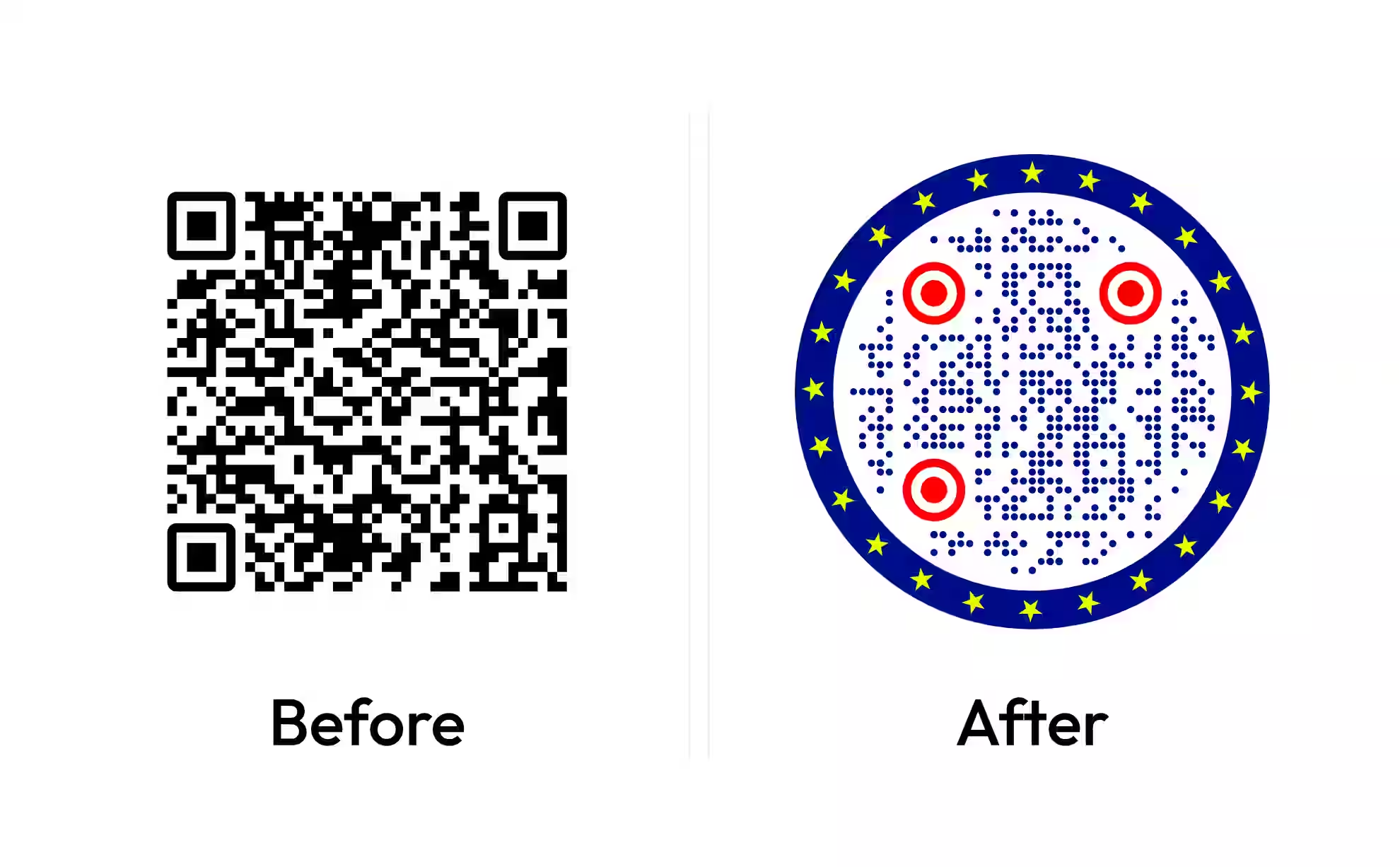
KoloQR, a free QR code generator with circular and custom-shaped QR codes, overlaps with QRCode Monkey almost exactly on the free part - static codes, no account, no watermark, no expiry, SVG, PDF and EPS export - and differs on that last rule, by changing the outline of the symbol rather than only the modules inside it. It is also open source, so the questions this article had to answer by measurement can be answered by reading the code instead.
It replaces nothing else. KoloQR has no dynamic codes, no scan analytics and no dashboard, and it is a newer tool than QRCode Monkey, which has years of use behind it and a template gallery that a newer tool cannot match by wanting to. If deep control over module and corner styling from a proven generator is the requirement, QRCode Monkey is the better answer, and our page on the open-source QRCode Monkey alternative sets out feature by feature where each one leads.
Make Your QR Code
Free, with no account and no watermark. Choose a shape, add a logo, check the contrast, and export SVG, PDF, EPS or PNG - a static code with no subscription behind it.
Generate QR CodeQuestions? Answered
It is really free. The static generator needs no account, adds no watermark, allows commercial use, and produces codes that its own FAQ says never expire and have no scan limit. The catch is a boundary rather than a bill: scan statistics and editable destinations are not part of it, and the links to those features open a signup for QR Code Generator PRO, a separate paid product on another site.
Because the PDF is a raster image inside a PDF page rather than a vector drawing. KoloQR downloaded one on 21 August 2026 and found a single 2320 × 2320 pixel image on a 2320-point page, which is 72 dpi at full page size. Download the .svg instead and export your own PDF from it if the printer needs PDF.
No. The codes are static, so the destination is encoded in the pattern rather than served by a company, and the site states that they "do not expire and will work forever" with no scan limit. A downloaded file keeps working even if the website disappears. What can stop working is the page you pointed it at, which is your own to keep alive.
Yes. Its FAQ answers this directly: "Yes, all QR codes you created with this QR generator are free and can be used for whatever you want." That covers packaging, signage, advertising and resale work. QR Code itself is a registered trademark of Denso Wave, which the site notes and which affects how you name the format in copy, not whether you may print one.
No. QRCode Monkey creates static codes and says so: "You just can't edit the content of the QR Codes again." Changing the destination means generating a new code and replacing every printed copy. If a destination might change, encode a URL on a domain you control and run the redirect yourself, so the printed pattern never has to change.
Its FAQ states: "We do not save or reuse your data in any form. We cache your qr code image files for 24h on our server to optimize the performance of QRCode Monkey." Codes are rendered server-side, so the content is transmitted either way. Worth remembering for Wi-Fi codes, which carry the network password in plain text, and vCards, which carry personal contact details.
It is a ceiling, not a recommendation. The 30% comes from error correction level H in ISO/IEC 18004, which can recover roughly that share of a damaged symbol - and printing, folding, scuffing and poor light all spend from the same allowance. Keep the logo well under the maximum and test the printed result rather than the screen preview.
The site's imprint names QRCode Monkey GmbH, Pariser Str. 47, 10719 Berlin, registered at the local court in Dresden under HRB 40482. It names no parent company. What the page does show is where its upsell points: signup links to app.qr-code-generator.com and bitly.com, carrying a user_source=qrcm parameter.
The site describes the API as free and publishes no price, no key requirement and no documented rate limit, and it invites anyone needing a custom solution to get in touch. It is the same endpoint the website's own download button calls. Treat an undocumented free API as a courtesy rather than a guarantee: nothing on the page promises availability, and the imprint disclaims liability for "faulty QR codes created with our generator".
Keep Exploring
Pages that pick up where this one leaves off - the same setting, the same kind of code, or the next thing worth deciding.
Do QR Codes Expire? The Pattern Never Does
The pattern never expires, and four things behind it do. Which one failed, how to tell them apart, and which of them you can fix without reprinting.
QR Tiger Is Free Twice Over, and Only One of Them Is Really Free
QR Tiger's free plan is two different offers wearing one label: unlimited static codes that cost nothing and outlive the company, and three dynamic codes capped at 500 scans that are paid for by the person holding the phone.
Unitag's Free QR Codes Stop Working After 100 Scans
Unitag's free QR code generator is free to use and free to download, and the code it produces is switched off after 100 scans. That is Unitag's own published rule, and it sits two clicks from a page advertising lifetime validity.
How to Create a QR Code in Canva and Export It So It Still Scans
The six steps to make a QR code inside a Canva design, the export setting that decides whether it prints sharp, and how to bring in a circular or vector code when Canva's square one is not enough.
KoloQR vs Unitag
A free open-source generator that hands you a print-ready vector file, compared with a European QR platform whose free download is a 300-pixel PNG limited to 100 scans. The deciding factor is whether the code you print has to survive its hundredth scan.
Fifty QR Code Colour Pairs, and Which of Them Survive Print
Fifty QR code colour pairs with the contrast ratio computed for each, grouped by whether they clear the print threshold, the screen one, or neither.
Why KoloQR?
- Create QR codes for websites, menus, Wi-Fi, PDFs, and business cards
- Customize colors, logos, and unique shapes
- Download high-quality PNG and SVG files
- Built for both print and digital