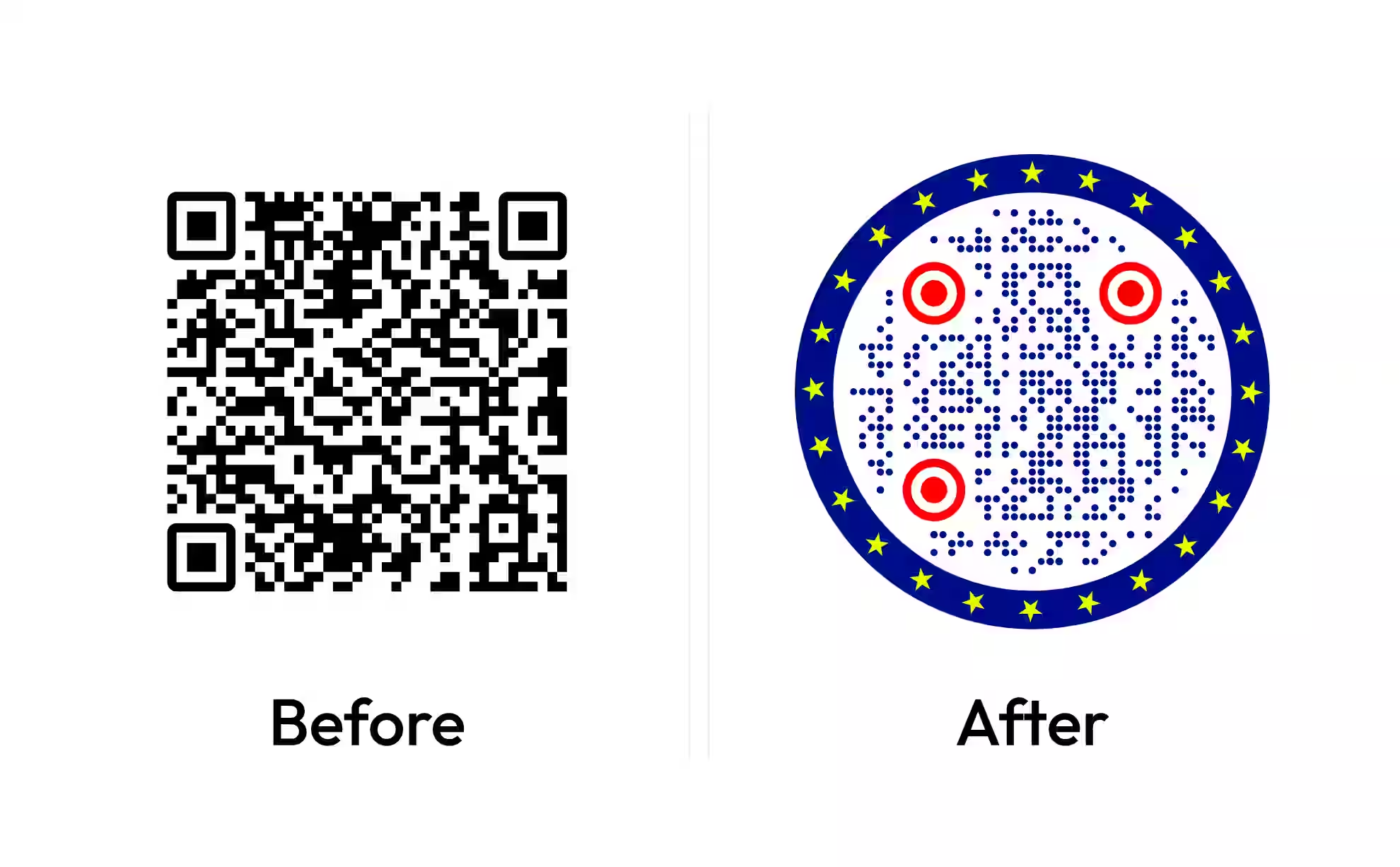
Seven Flowcode Alternatives and What Each Replaces
by KoloQR TeamIndustry
Flowcode's free plan covers 2 codes and analytics for 500 scans, and the first paid step is Pro Plus at $25 a month billed annually - which is where most people start looking for something else. Seven alternatives are worth knowing, and they fall into three groups: platforms that do the same job for less, one built for organisation-wide rollouts, and free static generators that do far less and never send an invoice. The part no pricing page mentions is that switching does not rescue a code that is already printed. Every price here was read off the vendor's own pricing page in August 2026.
Key Points
- Flowcode's pricing page lists a free plan with up to 2 Flowcodes and analytics for up to 500 scans, Pro Plus at $25 a month billed annually for up to 50 codes and 6,000 scans, and Growth at $250 a year starting at 150 codes and 10,000 scans.
- The cheapest like-for-like on this page is QR Tiger's Regular plan at $7 a month, which lists 12 dynamic codes with unlimited scans.
- QRCodeChimp has the most generous free dynamic tier here - 10 dynamic codes and 1,000 scans a month - and caps free downloads at 1024 × 1024 pixels, which is what decides your maximum print size.
- Uniqode's pricing FAQ states "We currently do not offer monthly plans" and, on cancellation, "If you decide to cancel your subscription, your QR Codes will become inactive."
- Switching platforms does not move a printed code. A dynamic code encodes the old provider's short link, so leaving means reprinting - which is why the static-versus-dynamic decision belongs before the print run rather than at renewal.
What Flowcode Costs in August 2026
Flowcode's free plan covers up to 2 Flowcodes with analytics for up to 500 scans. The first paid step is Pro Plus at $25 a month billed annually, which raises the allowance to 50 Flowcodes and landing pages, analytics for up to 6,000 scans, and 3 collaboration seats. Growth is listed at $250 a year, annual only, starting at 150 codes and landing pages with analytics included for the first 10,000 scans and geolocation data.
| Flowcode plan | Listed price | Codes and landing pages | Analytics allowance |
|---|---|---|---|
| Free | $0 | Up to 2 Flowcodes | Up to 500 scans |
| Pro Plus | $25 a month, billed annually | Up to 50 | Up to 6,000 scans, 3 seats |
| Growth | $250 a year, annual only | Starts at 150 | First 10,000 scans, with geolocation |
| Growth Plus | Usage-based, quoted | Not listed | Real-time dashboards, CRM and CDP integrations |
| Enterprise | Custom, quoted | Unlimited | Not listed |
The number worth watching in that table is the scan allowance rather than the price, because the allowance is the one that moves without you touching anything. A plan's price is fixed on the day you buy it, and a code's scan count is decided by how many people walk past the poster. On a metered plan, a campaign that works is the thing that pushes you to the next tier - a reasonable way to sell software, and an awkward way to budget a print run whose success you cannot predict.
Two of the five Flowcode tiers are quoted rather than listed, which is normal for enterprise software and worth naming plainly: if your requirement lands in Growth Plus or Enterprise, the comparison in this article stops being a price comparison and becomes a procurement exercise. The five alternatives below that publish their prices are easier to compare precisely because they publish them.
Why People Look for a Flowcode Alternative
Three things send people looking for a Flowcode alternative, and only one of them is the sticker price. The first is metering: allowances are counted in scans, so cost tracks traffic. The second is the shape of the ladder, where the step from the free plan to Pro Plus is 48 codes and $25 a month with nothing in between. The third is the dependency a dynamic code creates, which outlasts the subscription that created it.
A dynamic QR code is a code that encodes a short link belonging to the provider, which redirects to wherever you currently point it. That indirection is the entire product every platform in this article sells - the editable destination, the scan count, the landing page behind it - and it is also the reason a printed code stops being wholly yours. The pattern on the table tent points at the provider first and at your page second.
A scan cap is the limit a plan places on how many scans a code will serve or report, counted per code or per month. Read which of those two a cap actually does, because the difference decides whether an exhausted allowance costs you a report or costs you the code: Flowcode's free plan is worded as analytics for up to 500 scans, QR Tiger's free plan as 500 scans per code, and QRCodeChimp's free plan as 1,000 monthly scans. A cap on analytics stops the reporting. A cap on scans stops the sign working.
None of this makes Flowcode a bad purchase. It makes the free plan a demonstration rather than a tier you can run something on, which is true of almost every free plan in this category, and it is worth knowing before a design is signed off rather than after 2,000 flyers are boxed.
The Seven Alternatives at a Glance
The seven alternatives below are sorted by what they replace rather than by price. Five of them replace Flowcode's dynamic codes and analytics, at published prices from $7 a month upward. Two replace only the part of Flowcode that draws and exports the code, and they do that for nothing, permanently, and with no account behind it.
| Alternative | What it replaces | Entry price | Free tier |
|---|---|---|---|
| Uniqode | Flowcode at organisation scale - teams, integrations, compliance | Annual plans only | 14-day trial, no permanent free tier |
| QRCodeChimp | Dynamic codes plus landing pages, the closest thing to Flowpage | $9.99 a month, or $6.99 a month billed yearly | 10 dynamic codes, 1,000 scans a month |
| QR Tiger | Dynamic codes and scan analytics, at the low end | $7 a month | 3 dynamic codes, 500 scans per code |
| Bitly | QR codes sitting alongside short links in one account | $10 a month, billed annually | 2 QR codes a month |
| qr.io | Unmetered dynamic codes at one flat price | $39.99 a month, or $479.50 a year | 7-day trial, no permanent free tier |
| QRCode Monkey | The design and export step only | Free | The whole tool |
| KoloQR | The design and export step, with custom code shapes | Free | The whole tool |
The Platforms That Do the Same Job
Five platforms sell what Flowcode sells: a code whose destination you can change after printing, a count of how many people scanned it, and somewhere for them to land. They differ on how the allowance is metered, how the billing is shaped, and what the free tier is for.
Uniqode
Uniqode is the closest match to Flowcode for an organisation-wide rollout rather than a campaign, and its pricing FAQ is unusually direct about two conditions worth knowing before signing. On billing, it states "We currently only offer annual subscription plans" and "We currently do not offer monthly plans". On leaving, it states "If you decide to cancel your subscription, your QR Codes will become inactive."
Uniqode also states that static QR codes are permanent and will continue to work after cancellation, though the account becomes inaccessible, and it offers a 14-day trial and a 30-day money-back guarantee. Annual-only billing is the wrong shape for a single event and the right shape for a deployment across a hundred sites, which is roughly the line between choosing Uniqode and choosing something else - the per-feature detail sits on the Uniqode comparison.
QRCodeChimp
QRCodeChimp is the nearest substitute for Flowpage, because landing pages are part of the product rather than an upsell, and its published ladder is the gentlest here. Its pricing page lists a free plan with 10 dynamic codes, 1,000 monthly scans and unlimited static codes; Starter at $9.99 a month or $6.99 billed yearly for 50 dynamic codes and 10,000 scans; Pro at $19.99 or $13.99 yearly for 300 codes and 150,000 scans; and Ultima at $49.99 or $34.99 yearly for 900 codes and unlimited scans. Is QRCodeChimp free? sets out where the free plan's limits bite.
The figure to check on QRCodeChimp before anything is printed is not the scan allowance but the download resolution, which the pricing page caps by plan: 1024 × 1024 pixels on Free, 2048 × 2048 on Starter, and 4096 × 4096 on Pro and above. Those are raster limits, and a raster limit is a print-size limit - 1024 pixels is a comfortable flyer and a poor poster. The QRCodeChimp comparison covers what else the resolution cap touches.
QR Tiger
QR Tiger is the cheapest like-for-like alternative on this page. Its pricing page lists a free plan with 3 dynamic codes at 500 scans per code plus unlimited static codes, then Regular at $7 a month for 12 dynamic codes with unlimited scans, Advanced at $16 for 200 codes, and Premium at $37 for 600. Unlimited scans from $7 is the single most useful fact in this article for anyone whose problem with Flowcode is metering.
The free tier carries a condition stated on QR Tiger's own page: free codes come "With QR TIGER logo popup". A branded interstitial between the scan and your page is tolerable for an internal code and a poor experience on a restaurant table, where a customer meets somebody else's brand on the way to your menu. The QR Tiger comparison has the rest.
Bitly
Bitly is the sensible alternative when a team's short links already live there and nobody wants a second vendor. Its free plan, as listed in August 2026, allows 5 short links, 2 QR codes, 2 landing pages and 3 custom back-halves a month, with unlimited scans on what you create. Monthly QR allowances step up by plan: 2 on Free, 5 on Core, 10 on Growth and 200 on Premium.
One condition matters more than the allowance, and it is easy to misread. Bitly lists link and QR code redirects as a paid feature starting on the Core plan, which was $10 a month billed annually in August 2026 - so a free Bitly QR code is dynamic in construction and fixed in practice, because changing where it points is the paid part. The Bitly comparison sets out what the free tier does and does not include.
qr.io
qr.io is the only platform here that does not meter anything. There is one plan, Premium, listed at $39.99 a month or $479.50 a year, covering unlimited QR codes and unlimited scans, dynamic and static codes, PNG and SVG download, custom landing pages, scan analytics, API access, bulk creation and up to 5 team members, after a 7-day trial. There is no permanent free tier.
Flat pricing is worth arithmetic rather than instinct. At $39.99 a month, qr.io costs more than Flowcode's Pro Plus and less than several enterprise quotes, and it wins precisely where volume is unpredictable - a code on packaging, a code in a transport hub, anything whose scan count you would rather not have to forecast. It loses on a small, stable set of codes, where QR Tiger at $7 does the same job. The qr.io comparison covers the trial's terms.
The Free Static Generators That Do Less
Two tools on this list are not Flowcode alternatives in the feature sense, and they are the right answer more often than the feature sense suggests. Neither creates a dynamic code, counts a scan, or serves a landing page. Both produce a print-ready file that keeps working with nothing behind it, for nothing, indefinitely - which is the whole of what many people were using Flowcode for.
QRCode Monkey
QRCode Monkey is the established free static generator: no signup, PNG, SVG, PDF and EPS export, and detailed control over the body dots and the corner elements. Its own FAQ states that codes do not expire and will work forever, that there is no scan limit, and that a logo can cover up to about 30% of the code because error correction can recover that much.
One caveat on QRCode Monkey is stated on its own page and still costs people a print run: the logo and design settings currently only work for the .png and .svg files. If a printer asked for EPS or PDF and the vector went straight from the download panel to the press, the file can arrive as a plain code without the logo and styling. Open the export before it goes anywhere.
KoloQR
KoloQR, a free QR code generator with circular and custom-shaped QR codes, overlaps with the part of Flowcode people usually praise - how the code looks - and does it by changing the outline of the symbol itself: circular, rectangular, triangular and hexagonal, rather than only styling the dots inside a square. It exports SVG, PDF and EPS with no account and no watermark, checks contrast before you export, and copies straight into Figma. The source is open, so it can be inspected or self-hosted.
KoloQR replaces the drawing and exporting step and none of the rest. There are no dynamic codes, no scan analytics, no landing pages and no dashboard, so if the reason you are on Flowcode is the numbers, one of the five platforms above is the answer and KoloQR is not - which is the same conclusion the Flowcode comparison reaches at more length. KoloQR is also newer than Flowcode and than QRCode Monkey, which is a fair argument against it if what you want is a track record.
What Switching Actually Costs
Switching platforms does not rescue a code that is already printed. A dynamic QR code encodes a short link belonging to the old provider, so the pattern on the poster keeps pointing at that provider after you cancel, and Uniqode states the consequence outright: "If you decide to cancel your subscription, your QR Codes will become inactive." The real cost of leaving a QR platform is a reprint, not the difference between two monthly prices.
What transfers between platforms is the list: destination URLs, the design decisions, the artwork files. What does not transfer is the object in the world. That asymmetry is invisible while everything lives in a dashboard and becomes the entire problem the moment something is on a wall, a wine label, a vehicle or a laminated menu that was expensive to produce.
- Inventory What Is Already in the Field. List every printed code, where it is, how long it stays there, and what it points at today. Codes still in a box are not a constraint; codes on a wall are. This list, not the pricing page, is what decides how expensive leaving will be.
- Export the Static Codes Before the Account Closes. Any static code created on the old platform keeps working after cancellation, because the destination is encoded in the pattern rather than served by the provider - Uniqode says as much in its own FAQ. Download those files while the account is still open, since account access ends even though the codes do not.
- Keep the Old Plan Alive for the Printed Run Only. Downgrade the old subscription to the cheapest tier that keeps the existing dynamic codes resolving, and treat it as a maintenance cost on work already printed rather than as a tool you still use. Dual-running for a year is usually cheaper than reprinting a large installation.
- Print Everything New Against a Domain You Control. For anything printed from now on, encode a static URL on your own domain and do the redirecting on your own server. The printed pattern then points at you, the destination stays editable, and no future vendor decision can switch the code off. This is the only arrangement on this page that survives every provider.
- Retire the Old Plan When the Last Run Is Gone. Cancel once the printed material carrying the old provider's short links has been replaced or withdrawn. Check the inventory from step one rather than the calendar - a code on a permanent fixture outlives the campaign that commissioned it by years.
The decision that actually costs money is made before the print run, not at renewal. If a code will sit on a table tent for two years, the question is not which platform is cheapest this month but whose short link you are willing to have printed on your furniture for two years - and if the answer is nobody's, the code should have been static, or pointed at your own domain, from the start. That is covered at length in the note on what a dynamic QR subscription buys.
How to Choose, in Five Rules
Five rules sort every tool on this page, and they sort them better than a feature table because each one turns on a difference that cannot be worked around later.
- The destination will never change and nobody will count the scans. Use a free static generator - QRCode Monkey or KoloQR - and stop shopping. Menus, Wi-Fi codes, business cards, product labels and museum captions are almost all in this group, and every subscription above it buys infrastructure the project will not use.
- The destination will change, and there are only a few codes. QRCodeChimp's free plan, at 10 dynamic codes and 1,000 scans a month, covers more small projects than any other free tier here - as long as the 1024 × 1024 download cap is large enough for what you are printing.
- The destination will change and the traffic is real. Compare on the scan allowance rather than the headline price. QR Tiger's Regular plan lists unlimited scans on 12 codes for $7 a month; Flowcode's Pro Plus lists 6,000 scans for $25 a month billed annually. Which is cheaper depends entirely on how many people scan.
- The traffic is unpredictable and a cap would be a disaster. qr.io's flat $39.99 a month is the only plan on this page that does not move with volume, which is worth paying for on packaging, transport signage or anything else you cannot forecast.
- The rollout is organisation-wide. Uniqode is built for that shape of problem, and it bills annually only - so budget a year, and check the cancellation terms before the first code is printed rather than after.
- Nobody is sure yet. Print a static code that points at a redirect on your own domain. It costs nothing, it stays editable forever, and it removes this entire decision from the critical path.
Whichever tool wins, the one step worth insisting on is unglamorous: export the exact file you intend to print, on the plan you actually have, and scan it with two different phones at the size it will really appear. That catches more failures than any feature on any pricing page.
What None of These Replace
Flowcode's Audience Builder, its native CRM and CDP integrations, and the retail-scale deployment work around them are not matched by anything else on this page, and pretending otherwise would make this list useless. If the reason you are on Flowcode is first-party data flowing into a CRM and campaign optimisation on top of it, none of the five cheaper platforms is a drop-in replacement, and the honest recommendation is to stay and negotiate the quote rather than to switch and rebuild.
The failure that none of these platforms causes, and that most of them get blamed for, is a code that will not scan. A QR code fails because it is printed too small, because the contrast between the modules and the background is too low, because the quiet zone was crowded by a layout, or because a logo covered more of the pattern than the error correction level could recover. Those four decisions are made in whichever tool drew the code, and they are all fixable in the generator before the file leaves the screen - which is the only part of this comparison that decides whether the thing works at all.
Make Your QR Code
Free, with no account and no watermark. Choose a shape, add a logo, check the contrast, and export SVG, PDF, EPS or PNG - a static code with no subscription behind it.
Generate QR CodeQuestions? Answered
There is no single answer, because the alternatives split by job. For the same platform at organisation scale, Uniqode. For landing pages like Flowpage at a lower price, QRCodeChimp. For the cheapest dynamic codes with unlimited scans, QR Tiger at $7 a month. For unmetered volume, qr.io. For a designed code you print once and never pay for, QRCode Monkey or KoloQR.
Flowcode's pricing page, read in August 2026, lists a free plan with up to 2 Flowcodes and analytics for up to 500 scans, Pro Plus at $25 a month billed annually for up to 50 codes and landing pages with analytics for 6,000 scans and 3 seats, and Growth at $250 a year starting at 150 codes with the first 10,000 scans included. Growth Plus and Enterprise are quoted rather than listed.
Yes, in two different senses. For free dynamic codes, QRCodeChimp's free plan lists 10 dynamic codes and 1,000 scans a month, and QR Tiger's lists 3 codes at 500 scans each with a QR Tiger logo popup. For free static codes with no account, no watermark and no expiry, QRCode Monkey and KoloQR both export print-ready vectors - but neither can edit a destination or count a scan.
Dynamic codes on any of these platforms stop redirecting when the plan behind them ends. Uniqode states it plainly for its own product: "If you decide to cancel your subscription, your QR Codes will become inactive." Static files you exported keep working, because a static code carries its destination in the pattern. Check Flowcode's current terms directly before cancelling anything that is already printed.
No. A printed dynamic code encodes the old provider's short link, and no new provider can take over that link, so the pattern in the world cannot be reassigned. What you can move is the list of destinations and the design. Anything already printed either keeps the old subscription alive or gets reprinted - which is why the choice matters most before the print run.
Usually a scan cap rather than a fault. Free tiers meter scans - QR Tiger's free plan lists 500 scans per code, QRCodeChimp's lists 1,000 a month - and the code stops resolving once the allowance is spent. Read whether a plan caps scans or only caps analytics: a cap on analytics costs you a report, and a cap on scans costs you the sign.
QRCodeChimp is the closest, with landing pages included on paid plans and a free tier that carries 10 dynamic codes. Bitly includes landing pages too, at 2 a month on its free plan, and qr.io includes custom landing pages on its single subscription. Uniqode offers them as part of a broader platform. None of the free static generators serve pages at all.
Only for the design and export half of the job. KoloQR makes free static codes with custom outer shapes, free SVG, PDF and EPS export, no account and no watermark, and the codes never expire. It has no dynamic codes, no scan analytics, no landing pages and no dashboard, so it does not replace Flowcode for anyone who is there for the tracking.
Keep Exploring
Pages that pick up where this one leaves off - the same setting, the same kind of code, or the next thing worth deciding.
Best QR Code Generator in 2026: Six Free Tools Compared
Free resolves to three different arrangements - a code you keep, a code you rent, and a trial that ends - and the vendor's pricing page is rarely where the difference is stated.
How to Create a QR Code in Canva and Export It So It Still Scans
The six steps to make a QR code inside a Canva design, the export setting that decides whether it prints sharp, and how to bring in a circular or vector code when Canva's square one is not enough.
Do QR Codes Expire? The Pattern Never Does
The pattern never expires, and four things behind it do. Which one failed, how to tell them apart, and which of them you can fix without reprinting.
Static or Dynamic? Decide It Before Anything Is Printed
The difference is where the destination lives, and price, analytics and every failure mode follow from it. Four questions that settle which one to print.
QRCode Monkey Is Genuinely Free, and Its PDF Is Not Vector
QRCode Monkey's free tier is real, and two things in it are not what they look like - the upsell inside the editor, and a PDF export that turns out to be a picture of a QR code rather than a vector one.
A Free QR Tiger Alternative, No Signup
A design-first, open-source QR generator compared with a campaign-focused tracking platform. See which one fits your project.
Why KoloQR?
- Create QR codes for websites, menus, Wi-Fi, PDFs, and business cards
- Customize colors, logos, and unique shapes
- Download high-quality PNG and SVG files
- Built for both print and digital