How to Create a QR Code in Canva and Export It So It Still Scans
by KoloQR TeamIndustry
To create a QR code in Canva, open a design, select Apps in the side panel, search for QR code, paste the URL, and select Save. The QR code lands on the canvas as an element that can be moved and resized. Canva's QR code app is free to use with a Canva account and produces a square code with a choice of patterns, corner styles and colours. The steps are below, followed by the three things that decide whether a Canva QR code works in print: the export format, the printed size, and the contrast between the two colours.
Key points
- Canva creates a QR code from Apps, then QR code, inside any open design. The app is available on the free plan, options marked with a crown need a paid plan, and a Canva account is required before anything can be downloaded.
- Canva exports the whole design rather than the QR code alone. To get the code by itself, place it on an empty canvas sized to the code and export that.
- For print, download from Canva as PDF Print, which is 300 DPI. PDF Standard is 96 DPI, which is a screen resolution and prints a small QR code soft.
- A QR code in a Canva layout should be at least 2 cm wide for close scanning, with a clear margin of four modules on every side.
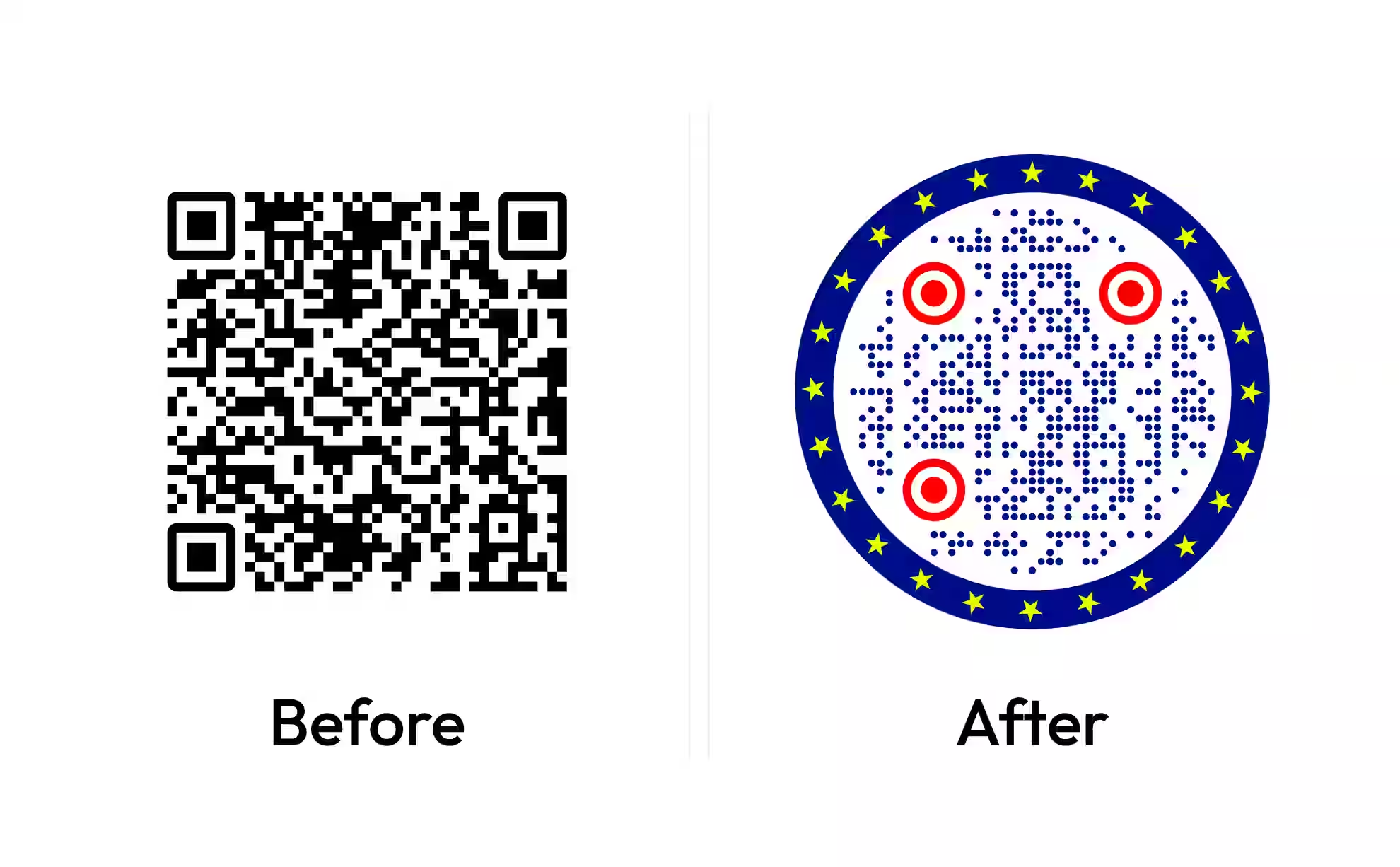
- Canva's QR code is always square. A circular, triangular or hexagonal QR code has to be generated elsewhere and uploaded to Canva as an SVG or PNG file.
How to Create a QR Code in Canva
Open any Canva design, select Apps in the side panel, search for QR code, enter the URL, and select Save. The whole procedure takes about two minutes. Canva moves its interface labels from time to time, so the steps below describe what to look for as well as what the button is currently called.
- Sign In and Open a Design. Sign in at canva.com and open the flyer, menu, business card or poster the QR code belongs on. To make a QR code on its own, create a custom-size design of 1000 x 1000 px instead.
- Open Apps in the Side Panel. Select Apps at the bottom of the left-hand side panel. On the Canva mobile app, tap the plus button first and scroll the bottom bar to Apps.
- Search for QR Code and Open the App. Type QR code into the Apps search box and choose the app published by Canva. Several third-party QR apps appear in the same results; those have their own sign-ups and limits.
- Paste the URL. Enter the full web address, including https://. Use the shortest address that works, because a shorter URL produces a QR code with fewer, larger modules that scans more easily at small sizes.
- Select Save and Position the Code. The panel confirms that the QR code is ready and the code appears on the canvas. Drag a corner handle to resize it so the code stays square.
- Choose the Pattern, Corners, Logo and Colours. The app panel has a Pattern menu, a row of Corners styles and a Logo row; options marked with a crown need a paid plan. The two colours are set from the colour swatches in the toolbar above the canvas. Keep the code dark on a light background, then scan it from the screen with a phone.
To change the destination later, select the QR code on the canvas, edit the URL in the app panel and select Save again. Whether copies that are already printed follow the change depends on whether the code is static or dynamic, which the section on static and dynamic codes below explains how to check.
What the Canva QR Code App Can and Cannot Do
Canva's QR code app covers the common case well: a square QR code for a URL, with a choice of module patterns, corner styles and colours, placed in a layout in one step. The app does not offer custom shapes, vector export of the code alone, a contrast check, or control over error correction. Those limits follow from the app being one element inside a design tool rather than a dedicated generator.
| Capability | Canva QR code app | What that means in practice |
|---|---|---|
| Encode a URL | Yes | Any web address works, including links to a PDF, a form or a social profile |
| Wi-Fi, contact card or calendar codes | No dedicated form | The app takes a URL; other code types need a generator that builds that format |
| Custom colours | Yes | Two colours, set from the toolbar, with no warning when the pair is too close to scan |
| Module pattern and corner styles | Yes | A Pattern menu and a row of Corners styles restyle the code without changing its data |
| Shape of the code | Square only | A round frame can be drawn around it, but the code inside stays square |
| Logo in the centre | Yes, with limits | The Logo row offers preset marks, including Canva's own; the options marked with a crown need a paid plan |
| Error correction level | No control | The app does not show or let you choose how much of the code can be covered or damaged |
| Download the code alone | No | Canva exports the design; the code must sit alone on its own canvas to be exported by itself |
| Vector file | Canva Pro | SVG export is a paid feature; PDF Print is available on the free plan |
| Download without an account | No | The editor asks for a sign-in before any export |
Check the Logo row before exporting, because a Canva QR code can carry Canva's own logo in its centre unless another option is chosen. Set the Logo row to none for a plain code. A logo chosen inside the app is allowed for when the code is drawn, which is safer than the alternative: dragging a separate image over the finished code covers modules the scanner needs.
Error correction is the redundancy built into a QR code that allows it to remain scannable when part of the symbol is covered. Canva's app gives no control over the error correction level, so a logo placed over the code by hand spends a reserve of unknown size. Keep a hand-placed logo under about a tenth of the code's area and test the result on two phones.
Are Canva QR Codes Static or Dynamic, and Do They Expire?
Canva has made both kinds. Canva's QR code app produced static codes for years, and Canva's help centre now also documents dynamic QR codes that can be re-pointed later, with scan insights marked as a paid feature in the editor. Which kind a given code is can be checked in under a minute, and it is worth checking before anything is printed.
A static QR code is a code whose destination is stored in the pattern itself, so the destination cannot be changed after the code is made. A static QR code does not expire: nothing sits between the scan and the page, so there is no scan limit and nothing to switch off. A dynamic QR code stores a short link owned by the provider instead, and keeps working for as long as that provider keeps the link alive.
- Download the Canva design, or take a clean export of the QR code.
- Decode the file with a tool that shows the stored text, such as the QR code scanner, rather than opening the link.
- If the decoded text is exactly the URL that was typed in, the code is static. If the decoded text is a different, shorter address that forwards to the URL, the code is dynamic and depends on that forwarding service.
The trade-off runs both ways. A static QR code cannot be edited after printing, so if the destination page moves, the printed code still points at the old address. A dynamic QR code can be edited, but its plan terms decide how long it lives; which Canva plan includes what is the kind of detail that changes, so check the current plan page.
There is a way to keep a printed static QR code editable without any subscription. Point the QR code at an address on a domain you control, such as example.com/menu, and set that address up as a 302 redirect to the real page. The printed code never changes and the redirect can be edited at any time. Static vs dynamic QR codes covers when each type is the right choice.
How to Download a Canva QR Code for Print
Select Share, then Download, and choose PDF Print for anything that will be printed. PDF Print exports at 300 DPI and offers crop marks and bleed. PDF Standard exports at 96 DPI, which is a screen resolution: a QR code exported at 96 DPI and printed 3 cm wide has roughly a third of the pixel detail per module that the 300 DPI file has.
| Where the QR code will be used | Canva download setting | Why |
|---|---|---|
| Professional print: flyers, menus, business cards | PDF Print, with crop marks and bleed if the printer asks | 300 DPI, and what a print shop expects to receive |
| Home or office printer | PDF Print, or PNG with the size slider raised | Keeps module edges sharp at final size |
| Website, email, social post | PNG | Lossless, so module edges stay hard |
| Large format: banners, signage | SVG on Canva Pro, otherwise PDF Print | A vector file scales to any size without softening |
| Anywhere | Not JPG | JPG compression smears the edges between dark and light modules |
To export the QR code without the rest of the design, create a new custom-size design of 1000 x 1000 px, generate or paste the QR code into it, and stretch the code to fill the canvas with its margin intact. Download that design as PNG for screen use. On the free plan the PNG size slider stops at the design's own dimensions, which is why the canvas should be made large to begin with.
Never take a screenshot of a QR code in the Canva editor and use that as the file. A screenshot records the code at whatever zoom level the editor happened to be showing, and the result is usually a few hundred pixels wide with softened edges.
How Big Should a QR Code Be in a Canva Design?
A QR code in a printed Canva design should be at least 2 cm wide for scanning at arm's length, and 3 cm is the safer minimum. As a rule of thumb, a QR code needs about 1 cm of width for every 10 cm of scanning distance, so a poster read from 2 m needs a code about 20 cm wide.
Canva shows element sizes in pixels by default, which hides the printed size. For a print design, create the design in millimetres or inches - A5, 148 x 210 mm, for a flyer, for example - and read the code's width from the position panel. A QR code that looks large on screen in an A3 poster template can still be under 2 cm on paper.
- Business card: 2 to 2.5 cm wide, with a short URL so the modules stay large.
- Flyer or menu held in the hand: 3 cm wide or more.
- Table tent read from a seat: 4 to 5 cm wide.
- Poster read from 2 m: about 20 cm wide.
A quiet zone is the empty margin around a QR code that lets a scanner detect where the symbol begins and ends, and the QR code standard, ISO/IEC 18004, sets it at four modules on every side. Canva templates are where the quiet zone most often gets lost: a code dropped into a decorative frame, tucked against a photo, or placed on a patterned background has no clear margin left. The minimum QR code size for print guide gives the sizes by material and distance.
How to Add a Circular or Custom QR Code to a Canva Design
Generate the QR code in a dedicated generator, download it as SVG or PNG, and upload the file through Uploads in Canva's side panel. The uploaded QR code then behaves like any other image in the design. This is the route for a circular code, a code with a logo built in, a vector code on the free Canva plan, or a Wi-Fi or contact code.
- Create the QR code in the generator of your choice and check that it scans on screen.
- Download the code as SVG for print, or as PNG at the final printed size and at least 300 DPI.
- In Canva, select Uploads in the side panel, then Upload files, and choose the file.
- Drag the uploaded QR code onto the canvas and resize it from a corner handle only, so it stays in proportion.
- Leave the code's own margin intact and keep other elements out of it.
KoloQR, a free QR code generator with circular and custom-shaped QR codes, fits this workflow because it exports the code by itself. KoloQR downloads SVG, PDF, EPS and PNG with no account, draws the symbol as a square, circle, triangle or hexagon, and checks the contrast of the chosen colours before download. KoloQR makes static codes only and has no layout tools, so Canva still does the flyer. The KoloQR vs Canva comparison sets the two side by side.
An uploaded SVG stays sharp at any size in Canva, including after the design is resized from a flyer to a poster. An uploaded PNG does not, so a PNG code should be exported at the largest size it will ever be printed at and only ever scaled down.
Why a Canva QR Code Does Not Scan
A Canva QR code that does not scan has usually been shrunk to fit the layout, coloured with too little contrast, or exported at screen resolution. The code Canva generates is valid; the failures come from what happens to it in the design afterwards.
| Symptom | Likely cause | Fix |
|---|---|---|
| Scans on screen, fails on paper | Exported as PDF Standard or a small PNG | Download again as PDF Print |
| Fails on paper at any distance | Printed under 2 cm, or a long URL made the modules tiny | Enlarge the code, or shorten the URL and regenerate |
| Some phones read it, others do not | Brand colours too close in lightness | Use a dark foreground on a light background; check the pair with a contrast tool |
| Never scans, even on screen | Light code on a dark background | Swap the colours, or put the code on a light panel |
| Stopped scanning after a design tweak | Stretched from a side handle, or another element overlaps the margin | Reset the proportions and clear four modules of space on every side |
| Scans, but opens the wrong or a dead page | The URL was mistyped or the page has moved | A static code cannot be edited; regenerate and reprint |
Transparency is a Canva-specific trap. Setting the QR code's transparency slider below 100 to blend it into a background lowers the contrast of every module at once, and the editor gives no warning. Keep a QR code fully opaque, and check colour pairs in the QR code contrast checker before the design goes to print.
Print one copy at final size before ordering the run, and scan it with one iPhone and one Android phone at the distance people will actually stand. For a wider list of causes, see why a QR code is not scanning.
Make Your QR Code
Free, with no account and no watermark. Choose a shape, add a logo, check the contrast, and export SVG, PDF, EPS or PNG - a static code with no subscription behind it.
Generate QR CodeQuestions? Answered
Yes. Canva's QR code app is included in the free plan, and a free Canva account is required to download the design. Options marked with a crown in the app - some logo choices and scan insights - need a paid plan, and so does SVG export. Check Canva's pricing page for the current boundaries.
The QR code option is in Apps, at the bottom of the side panel inside an open design. Type QR code into the Apps search box and choose the app published by Canva. Once a QR code is on the canvas, selecting it and choosing Edit reopens the same panel.
Yes. Open a design in the Canva app, tap the plus button, scroll the bottom bar to Apps, and search for QR code. The app takes a URL in the same way as on desktop. Export settings for print are easier to check on a desktop.
Only if the code is dynamic. The pattern of a static QR code is the address, so editing the URL draws a different code and printed copies keep the old destination. Decode the printed code to check: if it holds the typed URL, it is static. To stay flexible either way, point the code at a redirect on your own domain.
Yes, from the Logo row in the QR code app, where the options marked with a crown need a paid plan. Avoid dragging a separate image over a finished code instead: that covers modules the scanner needs, and the app offers no error correction setting to compensate. A code with a built-in logo can also be generated elsewhere and uploaded.
For a PDF, yes, indirectly: upload the PDF somewhere with a public link and paste that link into Canva's QR code app. For Wi-Fi, no - a Wi-Fi QR code uses a special text format rather than a URL, and Canva's app only accepts URLs. Generate a Wi-Fi code in a dedicated generator and upload the image.
Yes. Select Share in the Canva editor, create a public view link for the design, and paste that link into the QR code app in another design. Anyone scanning the code sees the live design. Public view links from Canva are long, so print the resulting code a little larger than usual.
Resizing from a corner handle is safe, because the code scales in proportion. Dragging a side handle crops or distorts the code and can cut into its margin. After any resize, check that the printed width is still at least 2 cm and that nothing else in the design touches the code's margin.
Keep Exploring
Pages that pick up where this one leaves off - the same setting, the same kind of code, or the next thing worth deciding.
Do QR Codes Expire? The Pattern Never Does
The pattern never expires, and four things behind it do. Which one failed, how to tell them apart, and which of them you can fix without reprinting.
Best Free QR Code Generators in 2026
Free resolves to three different arrangements - a code you keep, a code you rent, and a trial that ends - and the vendor's pricing page is rarely where the difference is stated.
Seven Flowcode Alternatives and What Each Replaces
Flowcode's free plan stops at 2 codes and 500 scans, and the first paid step is $25 a month - here is what seven alternatives cost, and why none of them can rescue a code that is already printed.
QRCode Monkey Is Genuinely Free, and Its PDF Is Not Vector
QRCode Monkey's free tier is real, and two things in it are not what they look like - the upsell inside the editor, and a PDF export that turns out to be a picture of a QR code rather than a vector one.
KoloQR vs Unitag
A free open-source generator that hands you a print-ready vector file, compared with a European QR platform whose free download is a 300-pixel PNG limited to 100 scans. The deciding factor is whether the code you print has to survive its hundredth scan.
Beauty Salons
Rebooking at the chair, per-service aftercare and a portfolio per stylist, with codes that survive acetone, colour and hairspray.
Why KoloQR?
- Create QR codes for websites, menus, Wi-Fi, PDFs, and business cards
- Customize colors, logos, and unique shapes
- Download high-quality PNG and SVG files
- Built for both print and digital