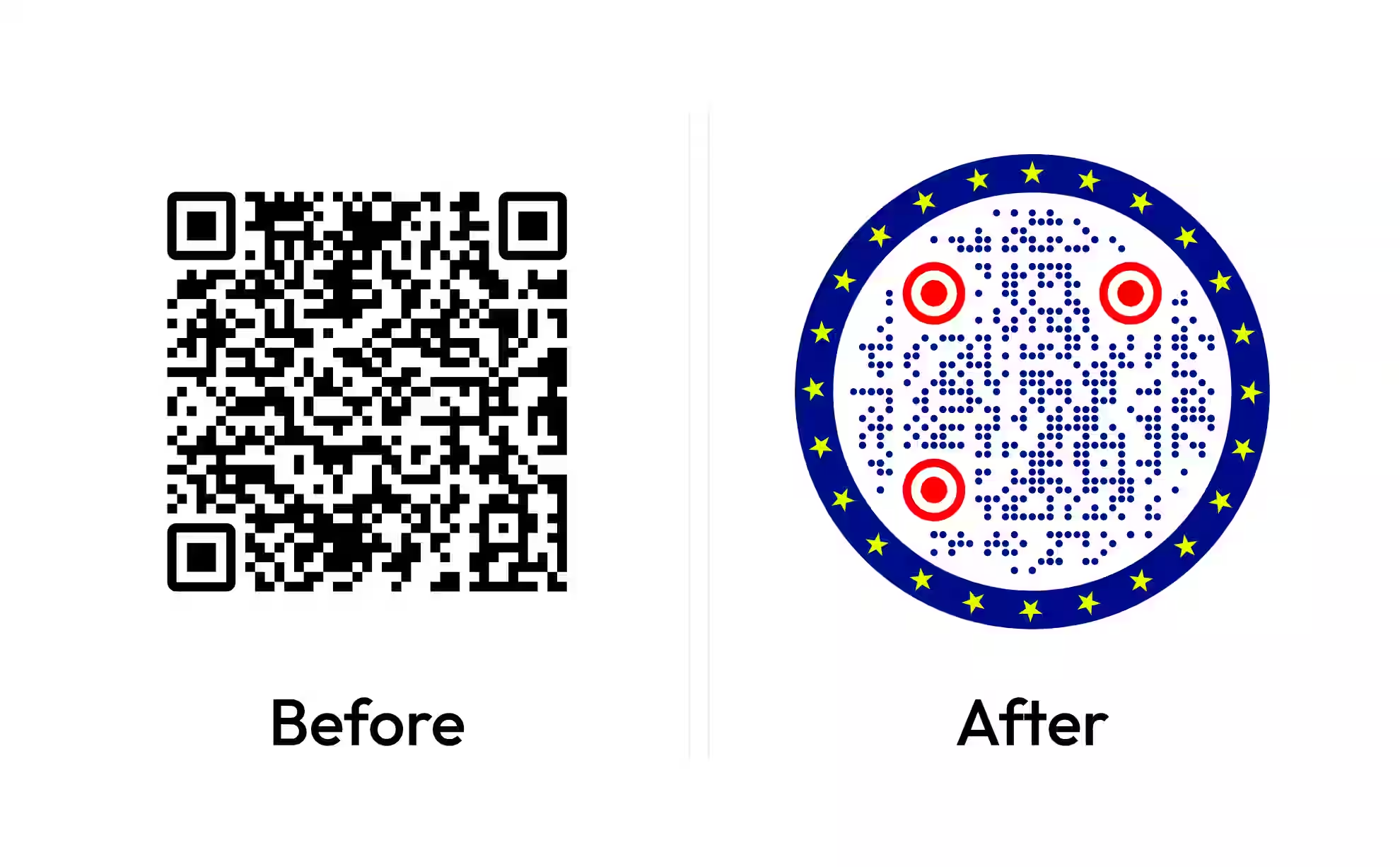
How Do You Put a QR Code on a Billboard?
Carefully, and often not at all. The same rule that sizes a poster says a billboard read from twenty metres needs two metres of QR code, and the people looking at one are usually moving. Make the code below, then read on for what each format needs and for the sites where a code earns the space it takes.
Opens in Google Maps. Coordinates work too - "37.4224, -122.0841".
The code opens your business's "Write a review" form. Paste the Place ID, or a Google Maps link that carries one.
A UPI link carries no checksum, so a mistyped ID produces a code that scans perfectly and pays somebody else. Paste the ID from your payment app rather than typing it, and send yourself one rupee before printing.
Paste it exactly as copied. KoloQR does not assemble the payload - it encodes the one your bank issued, and checks it before you print it.
SVG, PNG, JPG • Max 2 MB
First month free
then $9/month
Dynamic QR Codes Are Coming
Change your link anytime, even after printing. See who scans, when and where.
- Edit without reprinting
- Scan analytics
- Bulk & custom domains
You're on the List
We'll email you once, when dynamic codes with scan analytics launch.
What Size Should a QR Code Be on a Billboard?
One centimetre of code width for every 10 cm of viewing distance, the same rule as every other surface: 20-30 cm on a 6-sheet read from two or three metres, and about 2 m on a 48-sheet read from twenty. A 2 m code is two thirds the height of a 48-sheet, and that is the arithmetic most billboard codes lose to.
- The Formats, in Metres - a 6-sheet is 1.2 x 1.8 m and stands at pavement level, a 48-sheet is 3 x 6 m, a 96-sheet is 3 x 12 m. The 6-sheet is the only one of the three whose reader can walk up to it, which is why it is the only one where a code is routine.
- Measure the Line of Sight, Not the Ground - a panel 5 m up and 20 m back is 20.6 m away, and a building wrap 15 m up and 10 m out is 18 m away rather than 10. Take the diagonal, because that is the distance the camera actually works over.
- Angle Costs Width - a panel read at 45 degrees presents about 70% of its width to the camera, so the code needs to be roughly 40% wider to compensate. A billboard angled to catch passing traffic is almost never read square on.
- There Is a Maximum Range - a QR code is readable from about its own width out to roughly ten times it. A 2 m code works between 2 m and 20 m, so a reader standing at 40 m cannot scan it at any size the panel can hold.
Run the numbers before the layout, because a billboard code is either enormous or absent and there is no useful middle. The QR print size calculator does the sum for a distance and a payload, and the minimum size for print guide has the distance table it comes from. A code that works out larger than the space the design can give it is the answer rather than a number to round down.
Generate QR CodeWhat to Link a Billboard QR Code To
A billboard code is scanned by someone standing still near the panel - waiting for a bus, a train or a lift. These six destinations suit a reader who has a minute and nowhere else to be.
A Job Application
Recruitment hoardings on a pavement are the clearest win on this list. The reader is walking past the site they would work at, and the code removes the gap between noticing and applying.
A Ticket or Timetable
Station and airport panels, where the reader is already waiting and the scan answers the thing they are waiting about. Point it at the live timetable rather than at a transport homepage.
A Development or Property Page
Site hoardings around a build. Floor plans, availability and a contact form answer what a fence cannot, and the audience is standing on the street the development is on.
An App Download
Works only where the reader is stationary, which means concourses and shelters rather than roadsides. Link to a page that detects the platform instead of showing two store badges.
A Donation Page
Charity panels in transit spaces, where a scan converts the moment of attention. Suggest an amount on the page so the decision is one tap rather than a form.
A Local Offer
A voucher or booking for something within walking distance of the panel. The code's advantage over a printed URL is that it can carry the location and the offer without the reader typing anything.
How to Make a QR Code for a Billboard
Five steps, starting with the question that decides whether the other four are worth doing.
Generate QR Code- 1
Decide Whether the Reader Can Stand Still
Bus shelters, concourses, malls and pavement hoardings pass. Motorway and arterial sites do not, because the reader is driving. If nobody can stop, print a short URL and skip the code.
- 2
Measure the Diagonal and the Angle
Take the line of sight from where people stand to the middle of the panel, not the distance along the pavement, then add about 40% to the width if the panel is read at 45 degrees.
- 3
Cut the URL to the Fewest Modules
A short link drops the symbol version, and at billboard scale each version you avoid is centimetres added to every module. Use a short path on a domain you own.
- 4
Build It in Vector
Open the generator above, paste the link, then export SVG, PDF or EPS. Billboard artwork is usually supplied at a tenth of final size, and vector is what makes that scaling a non-event.
- 5
Proof It at a Tenth, at a Tenth of the Distance
You cannot print a 2 m test, but you can print a 20 cm one and scan it from 2 m. The optics are the same ratio, and it catches a payload that is too dense long before the panel goes up.
Pasted Sheets, Lighting and Dwell Time
A billboard is printed in sections, pasted by hand and then looked at by people who are either passing it or waiting near it. At that scale a module is the size of a beer mat, so print quality stops being the risk and placement, lighting and time take over.
- Modules the Size of a Beer Mat - a 2 m code on a version 4 symbol has 41 modules across, so each module is about 5 cm. Nothing in the printing threatens a square that big; the file only has to be vector so the edges stay hard.
- Seams Survive, Peeling Does Not - a pasted 48-sheet is assembled from sections, and a seam a few millimetres out inside a 5 cm module changes nothing. A lifting corner across a finder pattern kills the code outright, because that is the shape the scanner locates first.
- Illuminated Panels at Night - front-lit sites throw hot spots across the face and back-lit ones flatten the difference between dark and light modules. Look at the panel after dark before assuming the daytime scan still works.
- Digital Panels Have a Clock - on a digital billboard the code exists only while the slot runs. Ask the site owner how long that is, keep the code on screen for all of it, and hold it in the same position in every frame - QR codes in video ads works through the same arithmetic for screens.
The honest conclusion for roadside sites is that a short memorable URL beats a QR code. A driver at 50 km/h cannot hold a camera on a symbol, a passenger has a couple of seconds, and neither is served by two metres of pattern occupying the space the message needed - which is the same conclusion vehicle livery reaches about codes in traffic. Keep codes for panels people stand near, and run those files through the print checklist like any other print job.
Generate QR CodeBefore the Site Is Booked
Outdoor media is bought by the two-week cycle and printed once. These are the checks that decide whether the code belongs on the artwork at all.
Ask Where the Reader Stands
The site owner knows the viewing position for every panel they sell. A pavement, a platform or a queue makes a code viable; a carriageway does not, whatever the panel costs.
Size From the Diagonal, Then Add for the Angle
Height and set-back both add distance, and an angled panel loses width. Both corrections push the same way, so a code sized from the ground plan alone is always too small.
Put the Code Where a Phone Can Reach It
On a pavement-level panel that means the lower third, near eye height. On a raised panel it means accepting that the code is far away and sizing it accordingly.
Test the Ratio, Not the Poster
Print the code at a tenth of its final width and scan it from a tenth of the viewing distance. Same optics, same answer, one sheet of paper.
Print the URL Large as Well
Everyone who cannot stop, cannot scan or is too far away still has a way in. On a roadside site the readable URL is the primary route and the code is the extra.
Point It at a Redirect You Control
A campaign runs for two weeks; a photograph of the panel lives online for years. A redirect on your own domain means a scan from that photo lands somewhere useful long after the site is repapered.
Questions? Answered
About 1 cm of code width for every 10 cm of viewing distance. A 6-sheet read from two or three metres needs 20-30 cm; a 48-sheet read from twenty metres needs roughly 2 m, which is two thirds of its height. Measure the diagonal line of sight rather than the distance along the ground, and widen the code by about 40% if the panel is viewed at 45 degrees.
No, and this is the limitation worth designing around. Scanning needs a camera held steady on the whole symbol, which a driver cannot do and a passenger at road speed manages unreliably at best. For roadside sites, print a short memorable URL in large type and keep the QR code for panels people stand near.
They work where the reader is stationary and the code stays on screen long enough to be noticed, framed and decoded. Ask the site owner for the slot length, keep the code visible for the whole slot rather than the last seconds, and hold it in the same position throughout so a phone raised late still finds it.
About 2 m across for a panel read from twenty metres, on a face that is 3 x 6 m. At that width a version 4 symbol has modules roughly 5 cm square. If the layout cannot give up two metres, the honest options are moving to a pavement-level format or dropping the code and printing the URL.
Yes. A panel read at 45 degrees presents about 70% of its width to the camera, so the code has to be roughly 40% wider to look the same to a scanner. Angled sites facing traffic flow are the usual case. Ask which way the panel faces relative to the approach before finalising the artwork.
As low on the face as the design allows, and in the same place on every panel in the campaign. Low keeps the code nearer the reader on a raised site and puts it at eye height on a pavement-level one. Leave the quiet zone clear of the frame, which at billboard scale is a wide band of empty artwork.
Usually not. The arithmetic asks for a code larger than the layout wants to give, and the audience is moving past at speed with no way to hold a camera steady. A short URL does the job the code cannot. Codes belong on the outdoor formats people wait beside: shelters, concourses, hoardings and mall panels.
A vector file - SVG, PDF or EPS - even though the modules end up enormous. Billboard artwork is typically supplied at a tenth of final size, and a raster code scaled ten times arrives with soft edges no amount of size compensates for. Check the finished file with the QR code validator before it goes to press.
Keep Exploring
Pages that pick up where this one leaves off - the same setting, the same kind of code, or the next thing worth deciding.
Marketing Agencies
Produce campaign codes for client print runs: sized per placement, exported as vector, and pointed at a redirect the client keeps.
Vehicles
Vans, cars and fleet livery - the size a code needs at the kerb, and the part of the bodywork where it survives rivets, seams and road film.
Event QR Codes
One scan connects guests to tickets, schedules, directions and RSVPs - on invites, posters and signage.
Colored QR Codes
Put your palette on a QR code without breaking it: which color goes on the pattern, and which belongs on the frame.
Transparent QR Codes
Codes with no background of their own - which surfaces they scan on, which ones break them, and how to place one on photos, video, glass and clear labels.
Laser Engraving
Wood, anodised aluminium, slate, glass and steel - the file to export, the LightBurn settings, and the materials that invert the code.
Why KoloQR?
- Create QR codes for websites, menus, Wi-Fi, PDFs, and business cards
- Customize colors, logos, and unique shapes
- Download high-quality PNG and SVG files
- Built for both print and digital