How Do You Put a QR Code on a T-Shirt?
Fabric is the coarsest surface a QR code gets printed on, and the advice for it runs from one inch to twelve centimetres with no reasoning attached to either end. Make the code below, then read on for where the real floor comes from: the thread, the print method, and the distance a person will actually stand at.
Opens in Google Maps. Coordinates work too - "37.4224, -122.0841".
The code opens your business's "Write a review" form. Paste the Place ID, or a Google Maps link that carries one.
A UPI link carries no checksum, so a mistyped ID produces a code that scans perfectly and pays somebody else. Paste the ID from your payment app rather than typing it, and send yourself one rupee before printing.
Paste it exactly as copied. KoloQR does not assemble the payload - it encodes the one your bank issued, and checks it before you print it.
SVG, PNG, JPG • Max 2 MB
First month free
then $9/month
Dynamic QR Codes Are Coming
Change your link anytime, even after printing. See who scans, when and where.
- Edit without reprinting
- Scan analytics
- Bulk & custom domains
You're on the List
We'll email you once, when dynamic codes with scan analytics launch.

What Size Should a QR Code Be on a T-Shirt?
Print a chest code at 6-8 cm and a back code at 15-20 cm. Two numbers produce the chest figure: a scan happens at arm's length, about 50-60 cm, which the ten-to-one rule turns into 5-6 cm, and woven fabric needs modules around 0.8 mm, which turns a short URL into 3.3 cm at the absolute floor. Take the larger and leave margin.
- Where the Fabric Floor Comes From - a short URL at error correction M lands on a version 4 symbol, which is 41 modules wide including the quiet zone. At 0.8 mm per module - roughly double the 0.4 mm floor for coated paper, because ink spreads into the weave - that is 33 mm before any allowance for the wearer.
- Why One Inch Fails - 2.5 cm across a 41-module symbol puts each module at 0.6 mm, under what a cotton jersey holds. It decodes on a flat sample under a desk lamp and stops decoding on a person, at a distance, in a room with normal lighting.
- A Back Print Is a Different Sum - backs are read from 1.5 to 2 metres, which the same rule turns into 15-20 cm, about the width of an A5 sheet. A back code and a chest code are never the same artwork scaled; they are two sizes answering two distances.
- The Distance Manners Set - the scanning distance for a chest print is decided by how close a stranger will come, not by optics. Nobody leans in to 30 cm, so a code sized for 30 cm is sized for a distance that never happens.
Test the size on the garment rather than on the screen. Print one shirt, put it on a person, and scan it from where someone would really stand: fabric drapes, a chest curves, and both take tolerance out of a symbol that a flat sample keeps. The QR print size calculator gives the starting width for a distance and a payload, and the minimum size for print guide has the module arithmetic behind it.
Generate QR CodeWhat to Link a T-Shirt QR Code To
A shirt is worn by a person, which makes the scan a small social act. These six destinations are the ones worth that, most of them on shirts somebody is wearing as part of a job.
Event Staff Information
The strongest case on the list. A code on a crew shirt at a festival or a conference opens the schedule, the map or the guest Wi-Fi, and asking a person wearing it is already the normal thing to do.
A Merch or Release Page
Band and brand tees where the shirt is the advert. Point the code at the release, the tour dates or the shop, and keep the destination alive after the drop rather than letting it 404 while people still wear the shirt.
A Donation Page
Charity runs and awareness campaigns, where the wearer is asked about the shirt anyway. A code takes the conversation straight to a payment page while the person is still interested.
A Booking or Menu Page
Uniform shirts in cafes, salons and gyms. The code answers the question staff get asked twenty times a shift, and it works best on the back of the shirt where a customer can look without staring.
A Lead Form for Trade Shows
Booth shirts where the scan captures interest without a badge scanner. Keep it on the back or the sleeve, because a stand visitor will read a back at two metres and never lift a phone to a chest.
A Personal Profile or Portfolio
Hackathons, meetups and job fairs, where a shirt is the only thing you are guaranteed to be wearing. One link to a profile page beats a stack of cards that go in a bag.
How to Make a QR Code for a T-Shirt
Five steps in the order the garment forces. The print method comes first here, because it sets the smallest module the fabric will hold.
Generate QR Code- 1
Pick the Print Method First
DTF and heat transfer hold the crispest module edges, screen print spreads, DTG depends on the garment colour, and embroidery cannot do it at all. That choice sets your module floor before any size is decided.
- 2
Shorten the URL
Fewer characters means a lower symbol version, which means fewer and larger modules at the same printed width. On fabric that is the cheapest size you will ever buy.
- 3
Choose Error Correction With the Size in Mind
Higher correction adds modules, and more modules inside a 6 cm print means smaller modules. On a chest code, larger modules at level M or Q beat smaller ones at level H.
- 4
Build It in Vector
Open the generator above, paste the link, keep dark modules on a light background, then export SVG or PDF. Transfer and screen workflows both want vector, so the modules are drawn rather than resampled.
- 5
Print One and Wash It
Sample one shirt, scan it on a person from two metres and from arm's length, then wash it ten times and scan it again. That is the whole quality test, and it is the step a bulk order skips.
Dot Gain, Drape and the Wash
Fabric fights a QR code in three ways paper does not: the ink spreads into the weave, the garment curves on a body, and the print is then washed and tumbled. Each one takes tolerance out of the same symbol, which is why a T-shirt code has to start with more of it than a printed page needs.
- Screen Print Spreads Into the Gaps - plastisol sits proud of the fabric and creeps outwards, and on a code that creep closes the white gaps between modules rather than just thickening a line. Print the code larger rather than asking the shop to trap it thinner.
- DTF and Heat Transfer Keep the Edge - a transfer film carries the module edges as printed, which makes it the safest method for anything under 8 cm. It is also the method that cracks first, so nobody should iron over the print.
- DTG Depends on the Garment - direct-to-garment on white cotton is clean. On a dark shirt it needs a white underbase, and any misregistration between base and code shows up as grey fringing around every module, which is contrast the scanner was relying on.
- Embroidery Is Not a QR Code - stitch cannot hold a one-millimetre square, and thread rounds the corners of the finder patterns that a scanner locates the symbol by. Print it, or leave it off the garment.
Error correction is the trap on fabric. Level H recovers about 30% of a damaged symbol, which sounds exactly right for something that gets washed - but H adds modules, and more modules inside a fixed 6 cm print means smaller modules, which is the one thing fabric cannot hold. Keep the URL short and take level Q or M with larger modules over level H with smaller ones; error correction sets out what each level actually buys. Then run the file past the print checklist before the order goes in.
Generate QR CodeBefore the Print Run
Shirts are ordered in dozens and discovered to be wrong one at a time. These are the checks that fit between the artwork and the order.
Size for Arm's Length, Not for the Mockup
A code looks generous on a flat product mockup and small on a person. Six to eight centimetres on the chest, fifteen to twenty on the back, and check it on a wearer before the quantity is confirmed.
Keep It Off Seams, Pockets and Ribbing
A side seam, a pocket edge or a collar rib puts a step through the middle of the symbol. Centre chest and centre back are flat; almost everything else on a T-shirt is not.
Give the Quiet Zone Real Fabric
Four modules of blank garment on every side, which on a 6 cm code is about 6 mm. On a graphic tee the surrounding artwork is what eats it, and the code stops being findable rather than stops being readable.
Keep Dark Modules on Light Fabric
Print the code inside a light panel on a dark shirt rather than reversing it out. Inverted codes decode on some phones and not others, and a bulk order is a bad place to discover which phones your audience carries.
Wash the Sample Ten Times
Cold wash, inside out, no tumble dry, then scan it again. Cracking and fade lower contrast gradually, and ten cycles is enough to show whether the print will outlive the season.
Check the Scan Is Worth Asking For
Pointing a phone at a person's chest is uncomfortable, and no size fixes that. Put the code on the back, or on a shirt worn by someone whose job is to be asked, and the awkwardness goes away.
Questions? Answered
About 6-8 cm on the chest and 15-20 cm on the back. The chest figure comes from arm's length - roughly 50-60 cm of scanning distance at 1 cm of code per 10 cm of distance - and from the fabric floor, which needs modules near 0.8 mm. Both land in the same place, so anything under 5 cm is optimistic.
Not reliably. A short URL at error correction M is 41 modules wide including its quiet zone, so 2.5 cm puts each module at 0.6 mm, below what woven cotton holds once the ink spreads. It scans on a flat sample under good light and fails on a person across a room, which is where the code has to work.
DTF or heat transfer, because the film carries the module edges exactly as printed. Screen print works above about 8 cm if the printer knows a code is on the artwork and does not trap it thinner. DTG is fine on white cotton and needs care on dark garments, where the white underbase has to register precisely.
Usually, if the print does. The code has no expiry of its own - a static pattern holds the link inside it - so what degrades is the ink: transfers crack, prints fade, contrast drops. Wash inside out, cold, without tumble drying or ironing the print, and test a sample through ten cycles before ordering in bulk.
Usually not on a small chest print. Level H recovers about 30% of a damaged symbol but adds modules, and inside a fixed 6 cm print those extra modules are smaller ones - the opposite of what fabric needs. Shorten the URL and take Q or M with bigger modules. On a large back print, H costs nothing worth having.
Yes, by printing a light panel and putting a dark code inside it. Reversing the code out as white modules on black relies on the phone handling an inverted symbol, which iOS and Android decoders do not treat identically. A pale rectangle behind the code keeps the contrast the scanner expects and reads on any camera. Halloween QR codes covers costume codes, where black fabric is the usual starting point.
On staff and event shirts, often. On a stranger's chest, rarely - lifting a phone to someone's torso is uncomfortable, and most people will not do it. A back print scanned at two metres removes the problem, which is why crew shirts, festival staff and stand teams are where clothing codes earn their place.
Not usefully. Stitch cannot hold module edges at the sizes a garment allows, and thread rounds the finder patterns a scanner uses to locate the symbol. An embroidered code has to be very large before it decodes at all. Print the code on a transfer and embroider the logo instead - see the same trade-off on stickers and labels, where the substrate also sets the floor.
Keep Exploring
Pages that pick up where this one leaves off - the same setting, the same kind of code, or the next thing worth deciding.
Photographers
Client galleries, print reorders, portfolio links and guest photo uploads, on cards, albums, prints and event signs.
Flyers
A5, A6 and DL leaflets - what size the code needs, which corner it belongs in, and how to tell which batch produced the scans.
Event QR Codes
One scan connects guests to tickets, schedules, directions and RSVPs - on invites, posters and signage.
X (Twitter) QR Code
Send people straight to your X profile, a single post, or a one-tap follow prompt.
Google Forms QR Code
Open a survey, sign-up sheet, or feedback form straight from a printed page.
Billboards
48-sheets, 6-sheets and building wraps - what the distance arithmetic asks for at that scale, and the placements where it argues against a code entirely.
Why KoloQR?
- Create QR codes for websites, menus, Wi-Fi, PDFs, and business cards
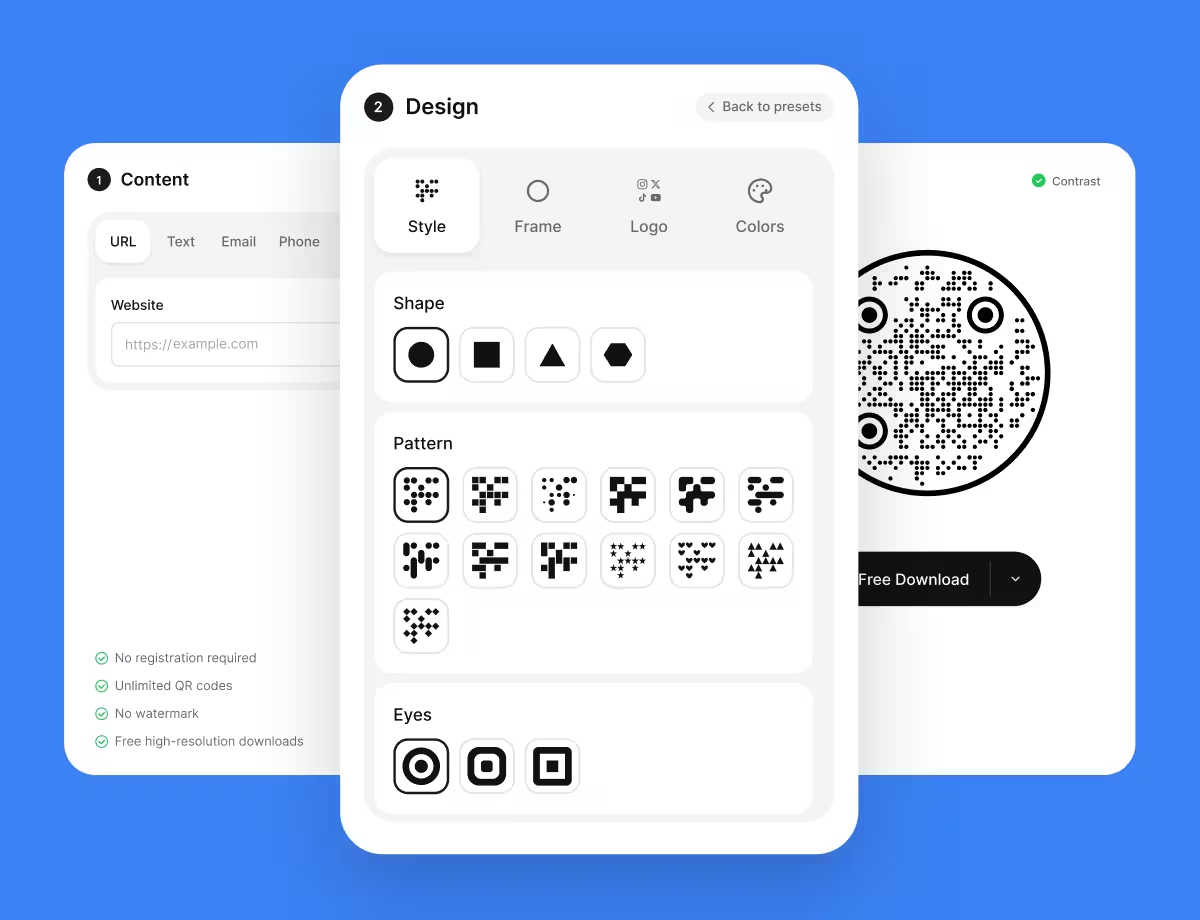
- Customize colors, logos, and unique shapes
- Download high-quality PNG and SVG files
- Built for both print and digital